
Manglik Dosh: Meaning, How to Check, Cancellation and Remedies
 By Monica Kapoor · Vedic astrologer & tarot mentor · Masters in Vedic Numerology · 15+ years of practice
Manglik Dosh (also called Mangal Dosh or Kuja Dosha) forms when Mars sits in the 1st, 2nd, 4th, 7th, 8th or 12th house of your kundli. It is very common. In many charts it is mild or cancelled by other placements. When it is active, it shows up mostly as anger, ego clashes and delays in marriage, and it has well-known remedies.
The moment a pandit ji says the word “Manglik” during a rishta discussion, the whole mood of the house changes. Parents start worrying, horoscopes get sent to three more astrologers, and the person who is Manglik often feels as if something is wrong with them.
Nothing is wrong with you. Mars falls in one of these six houses in a very large share of charts, so being Manglik is common. What matters is how strong the dosh is and whether something else in your chart already balances it. In this guide I’ll explain how to check that yourself, how the dosh gets cancelled, what it actually does in a marriage, and the remedies I trust.

What is Manglik Dosh? (Manglik meaning)
Manglik Dosh is a placement of Mars (Mangal) in a house connected with marriage, family, home or the bond between partners. It goes by several names: Mangal Dosh, Kuja Dosha (South India) and Bhauma Dosh. All of them mean the same thing.
Mars is the planet of energy, courage, drive and action. Those are good qualities. But Mars is also hot and quick to react. When it sits in the houses that govern married life, that heat can come out as impatience, sharp words or a need to win every argument. That is the whole idea behind the dosh: too much Mars energy in the area of life where you most need patience.
Two things are worth knowing before you worry:
- It is a placement, not a curse. A Manglik person usually has strong willpower and works hard. The same energy that causes arguments also helps you build a career and protect your family.
- The rule comes from tradition, and traditions differ. North Indian astrologers usually check the 1st, 4th, 7th, 8th and 12th houses. Many South Indian astrologers also include the 2nd house. That is why two astrologers can give you two different answers on the same chart.
Manglik check: how to know if you are Manglik
You need your exact date, time and place of birth. If your birth time is off by even 15–20 minutes, the lagna can change, and with it the house Mars falls in. So start with the right data.
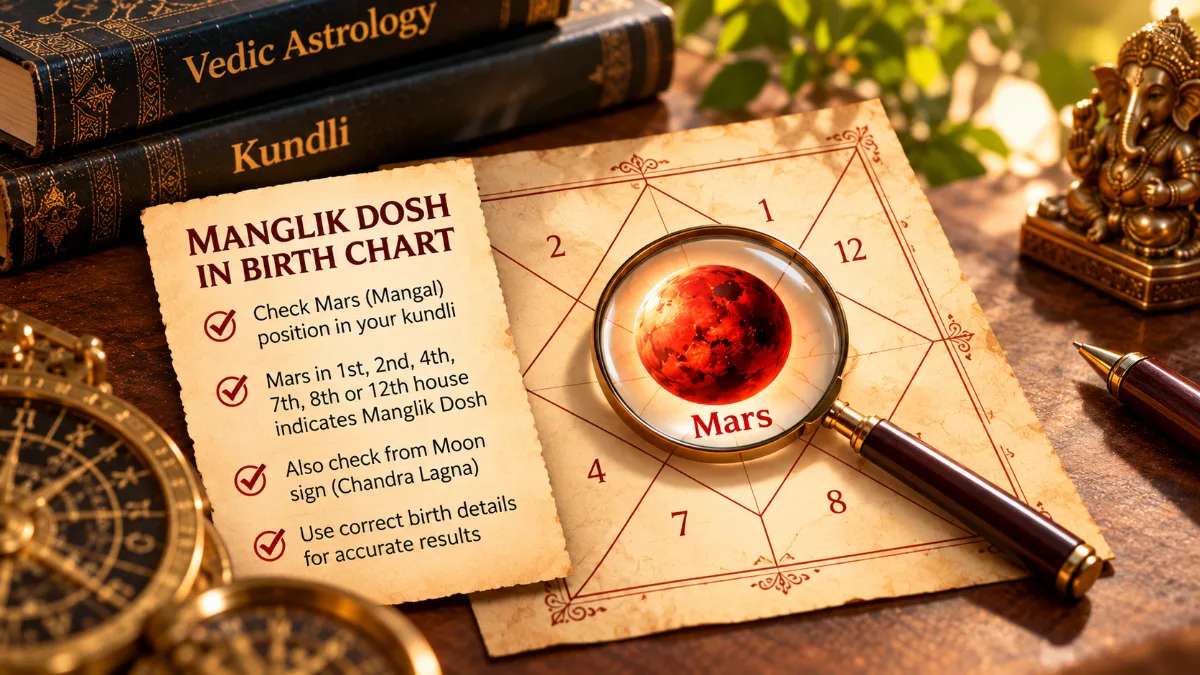
- Make your kundli with your exact birth date, time and place.
- Find Mars. In Hindi kundlis it is written as “Ma” or “मं”.
- Count from the lagna. The lagna is house 1. In a North Indian chart it is the top centre diamond. Count anti-clockwise to the house where Mars sits.
- Check the six houses. If Mars is in the 1st, 2nd, 4th, 7th, 8th or 12th house from the lagna, you are Manglik from the lagna.
- Repeat from the Moon and from Venus. Treat the house where the Moon sits as house 1 and count again. Then do the same from Venus. The more of these three points Mars is “Manglik” from, the stronger the dosh.
Online Manglik Dosh calculators do step 4 for you, but most skip step 5 and almost none check for cancellation. Use them as a first look, not a final answer. If marriage decisions depend on it, have the chart read properly. A kundli reading covers all three reference points and the cancellation rules together.
What Mars does in each house
| House | Area of life | How Mars can show up in marriage |
|---|---|---|
| 1st | Self, temperament | Bold, quick-tempered, wants things done their way |
| 2nd | Family, speech | Harsh words said in the moment; friction with the family |
| 4th | Home, peace of mind | Restlessness at home, frequent moves, ups and downs in domestic happiness |
| 7th | Spouse, partnership | Ego clashes, arguments, a strong-willed partner |
| 8th | In-laws, sudden events | Sudden upheavals, tension with in-laws |
| 12th | Bed comforts, expenses | Emotional distance, overspending, disturbed sleep or intimacy |
The 7th and 8th houses are usually read as the strongest Manglik placements. The 12th and 2nd are usually the mildest.
High Manglik vs Anshik (low) Manglik
Families often hear only “Manglik” or “not Manglik”. In practice, there are degrees. This is the single most useful thing to ask your astrologer.
| High (Poorna) Manglik | Anshik (partial / low) Manglik | |
|---|---|---|
| Where Mars is | In a Manglik house from the lagna, and also from the Moon and/or Venus | In a Manglik house from only one point, usually the Moon or Venus |
| Strength of Mars | Mars is strong or afflicted, with no helping aspects | Mars is weak, or aspected by Jupiter |
| Cancellation | No cancellation condition applies | One or more cancellation conditions apply |
| What it means | Matching and remedies are taken seriously | Often treated as non-Manglik for matching; simple remedies are enough |
Effects of Manglik Dosh
The effects depend on the house, the sign Mars is in, and what else touches Mars. An active dosh does not mean a bad marriage; plenty of Manglik people have loving, stable marriages. When the dosh is strong and not cancelled, these are the patterns traditionally linked to it:
- Delays in marriage, or rishtas that fall through at the last stage.
- Anger and ego clashes with the partner, especially over small things.
- Impatience: wanting the relationship to move at your speed.
- Tension with in-laws or within the joint family.
- Sudden ups and downs, such as a job loss, a move or a family dispute, landing on the marriage.
Traditional texts also link an afflicted Mars to blood pressure, inflammation and injuries. Treat that as a reason to look after your health, not as a diagnosis. Any health concern belongs with a doctor.
Manglik Dosh and marriage
This is the part that worries families most, so let me answer it directly.
Should a Manglik only marry a Manglik?
That is the traditional advice. When both partners have the same Mars energy, it balances out: neither feels the other is too aggressive, and the dosh is considered cancelled. It is not the only way, though. A Manglik can marry a non-Manglik when the dosh is low or cancelled, or when the partner’s chart has its own balancing factors.
How Manglik Dosh is checked in kundli milan
The usual 36-guna Ashtakoot matching does not include Manglik Dosh. It is checked separately, alongside the guna score. So a match can score 28 gunas and still need a Manglik check, or score low and have no Manglik issue at all. Both partners’ charts are checked for Mars, then for cancellation, before anyone decides. The 36 gunas themselves come from the two partners’ birth nakshatras; my nakshatra gana, yoni and nadi table shows the values for all 27.
Manglik Dosh for men and women
The dosh works the same way for both. The rules for checking and cancelling it are the same. Only the pre-wedding ritual differs: Kumbh Vivah is done for women and Ark Vivah for men. I explain both below.
Not sure if the dosh in your match is high, low or cancelled?
Send me both birth details. I’ll check Mars from the lagna, the Moon and Venus in both charts, look for cancellation, and tell you plainly whether any remedy is needed.
When does Manglik Dosh get cancelled?
This is the good news that most families never hear. In a lot of charts, the dosh is cancelled by other placements. This is called Manglik Dosh Bhang or Mangal Dosh Parihar. Before you plan any remedy, check whether one of these applies:
| Condition | Why it cancels or weakens the dosh |
|---|---|
| Both partners are Manglik | Equal Mars energy on both sides balances out |
| Mars in its own sign: Aries (Mesh) or Scorpio (Vrishchik) | Mars is comfortable in its own sign and behaves well |
| Mars exalted in Capricorn (Makar) | Mars is strong and disciplined, so its energy is constructive |
| Jupiter (Guru) conjunct or aspecting Mars | Jupiter’s wisdom calms Mars’s aggression |
| Mars conjunct the Moon | The combination (Chandra-Mangal yoga) is traditionally treated as a cancellation |
| Jupiter or Venus in the 1st house | A benefic on the lagna protects the native and the marriage |
| Partner has Saturn, Rahu or Ketu in a Manglik house | Similar malefic energy in the partner’s chart balances the match |
| Specific sign and house combinations | For example, Mars in the 2nd in Gemini or Virgo, or in the 12th in Taurus or Libra, is commonly said not to form the dosh |
Different schools accept slightly different lists, so you will see variations. Even one strong cancellation usually turns a “high” Manglik into an anshik one.
Does Manglik Dosh end after 28?
There is a popular belief that Mars “matures” at 28 and the dosh weakens after that age. Many astrologers follow it and some don’t. I treat it as one factor, not a rule. Mars’s dasha periods and transits matter more than a fixed birthday, so it is better to check your chart than to wait for 28.
Remedies for Manglik Dosh
If your dosh is active and not cancelled, there is still no need to panic. These remedies calm Mars’s energy. Start with the simple ones. Rituals like Kumbh or Ark Vivah are only needed when the dosh is high.

Everyday remedies (for anshik and high Manglik)
- Worship Lord Hanuman. Hanuman ji is said to govern Mars. Read the Hanuman Chalisa daily, or at least on Tuesdays, and visit a Hanuman temple. Reading the Sundarkand on Tuesdays is also traditional.
- Fast on Tuesdays (Mangalwar). Even a partial fast with one meal works. Avoid alcohol and non-vegetarian food on Tuesdays.
- Chant the Mangal beej mantra. Chant “Om Kram Kreem Kroum Sah Bhaumaya Namah” 108 times on Tuesdays.
- Donate red items on Tuesdays. Give red lentils (masoor dal), jaggery, red cloth or copper to someone in need.
- Work on the anger itself. This is the part people skip. Mars energy needs an outlet, so regular exercise, sport or physical work is a real remedy. So is agreeing as a couple to stop an argument and pick it up later.
Rituals before marriage (for high Manglik)
- Kumbh Vivah (for women). Before the actual wedding, the bride is symbolically married to a clay pot (kumbh). In some traditions she is married to a peepal or banana tree, or to an idol of Lord Vishnu. The belief is that the harsh effect of Mars goes to the pot or tree.
- Ark Vivah (for men). The groom is symbolically married to the Arka plant (aak, Calotropis), usually on a Saturday or Sunday, before the actual marriage.
- Mangal Dosh Shanti Puja. This can be done at home through a pandit. Many families travel to the Mangalnath Temple in Ujjain, which is traditionally linked to Mars, for this puja.
Gemstone for Manglik Dosh: Red Coral (Moonga)
Red Coral is the gemstone of Mars. When Mars is a friendly planet for your lagna, a natural red coral can steady its energy and turn the anger into courage and confidence. Traditionally it is worn on the ring finger, set in copper or gold, on a Tuesday morning after the stone is energised with a puja.
Two cautions:
- Don’t wear it without a chart check. For some lagnas Mars is not a friendly planet, and the stone can strengthen exactly the energy you are trying to calm.
- Buy only natural, lab-certified coral. Dyed, treated or imitation coral has no astrological value. Ask for a certificate from a recognised gem lab.
Remedies work best alongside behaviour. If Mars is creating anger in your chart, the most powerful remedy is noticing the moment you are about to say the harsh thing, and not saying it.
Myths about Manglik Dosh
- “A Manglik’s spouse will die.” This is the fear that does the most damage, and it is not how the dosh is read. The 8th house is linked with sudden events and the longevity of the marriage, and over time that got exaggerated into a death sentence. No single placement decides anyone’s lifespan.
- “Manglik people can never marry a non-Manglik.” They can, when the dosh is low or cancelled, or when the partner’s chart balances it.
- “One online calculator settles it.” Most calculators check only from the lagna and ignore cancellation. Many people told they are “high Manglik” online turn out to be anshik.
- “Kumbh Vivah is compulsory for every Manglik girl.” It is meant for strong, uncancelled cases, not for every Manglik chart.
From my readings
How I check a chart for Manglik Dosh
When a family sends me a kundli because someone has been called Manglik, I don’t start with remedies. I go through the chart in this order:
- Verify the birth time. If the time is a rough guess (“around evening”), I say so before anything else. A wrong lagna gives a wrong Manglik result.
- Locate Mars from three points: the lagna, the Moon and Venus. I note each one separately.
- Judge the strength of Mars: its sign, whether it is in its own sign, exalted or debilitated, and what aspects it receives, especially from Jupiter.
- Go through the cancellation conditions one by one, before calling anyone “high Manglik”.
- Look at the partner’s chart if a match is being considered, because the balance between two charts matters more than one chart alone.
- Check timing: whether a Mars mahadasha or antardasha is running or coming up, because that is when the placement is most active.
- Only then suggest a remedy, and only as strong as the dosh actually is.
A worked example
This is an example chart built to show the method. It is not a client’s chart.
| Placement | What it shows |
|---|---|
| Lagna: Taurus (Vrishabh) | Counting starts from Taurus as house 1 |
| Mars: Scorpio (Vrishchik), 7th house | Manglik from the lagna, and the 7th is a strong Manglik house |
| Moon: Cancer (Kark), 3rd house | From the Moon, Mars falls in the 5th house, so not Manglik from the Moon |
| Venus: Taurus, 1st house | From Venus, Mars is 7th, so Manglik from Venus |
At first glance this person looks strongly Manglik: Mars in the 7th from both the lagna and Venus. A calculator would say exactly that. But two cancellation conditions apply. Mars is in Scorpio, its own sign, and Venus sits in the lagna. And from the Moon there is no dosh at all. My reading of this chart would be anshik Manglik with strong cancellation. I would not ask this family to arrange a Kumbh Vivah, and for a match I would look at the partner’s 7th house rather than insist on a Manglik partner.
There is one more lesson in this chart. For a Taurus lagna, Mars rules the 7th and 12th houses and is not a friendly planet for the native. So even though this person is “Manglik”, red coral is not the right remedy here. Wearing it could strengthen the very energy the family is worried about. Hanuman Chalisa and Tuesday donations would be my suggestion instead. This is why I always say: never wear a gemstone just because a website says you are Manglik.
What I tell every worried family first
Three things. Being Manglik is common, so you are not unusual. The word on its own tells you nothing until you know whether the dosh is high, anshik or cancelled. And no remedy should be chosen out of fear. Mars responds to discipline, patience and devotion, not to panic.
This example combines details from several readings and changes them so no family can be identified.
A mother brings me her daughter’s kundli after two rishtas have fallen through. Three different astrologers have called the girl “high Manglik”, and the family is already planning a Kumbh Vivah. In the chart, Mars is in the 4th house from the lagna, which does make her Manglik. But Mars sits in Aries, its own sign, and Jupiter aspects it from the 10th house. From the Moon and Venus there is no dosh at all. This is an anshik Manglik with two cancellations. I tell the family that Kumbh Vivah isn’t needed. I suggest Hanuman Chalisa on Tuesdays and ask them to check the boy’s 7th house during matching, rather than look only for a Manglik boy.
I see some version of this again and again: the word “Manglik” causing more worry than the chart itself justifies.
“Her predictions regarding my situation were spot on, and she explained everything so clearly. The remedies she gave me were simple to follow.”
— Srinidhi Naidu
“She has thorough knowledge and gives genuine answers without sugar coating with easy to follow remedies.”
— Shobhit Agrawal
Testimonials as published on divinemonica.com.
When you should get your chart checked
- A rishta is on hold because one side is Manglik.
- Different astrologers have told you different things.
- You are planning Kumbh or Ark Vivah, or to wear red coral.
- Your birth time is uncertain. In that case birth time rectification comes before any Manglik decision.
मांगलिक दोष क्या है?
जब कुंडली में मंगल ग्रह पहले, दूसरे, चौथे, सातवें, आठवें या बारहवें भाव में होता है, तो इसे मांगलिक दोष (मंगल दोष) कहते हैं। यह बहुत आम है और कई कुंडलियों में दूसरे ग्रहों की स्थिति से अपने आप रद्द हो जाता है। मांगलिक दोष की जाँच लग्न, चंद्रमा और शुक्र, तीनों से की जाती है। अगर दोष सक्रिय है, तो हनुमान चालीसा, मंगलवार का व्रत और मंगल मंत्र जैसे सरल उपाय मदद करते हैं। कुंभ विवाह (लड़कियों के लिए) और अर्क विवाह (लड़कों के लिए) केवल प्रबल दोष में किए जाते हैं।
Conclusion
Manglik Dosh forms when Mars sits in the 1st, 2nd, 4th, 7th, 8th or 12th house. It is common, it comes in degrees, and in many charts other placements cancel it. Check it from the lagna, the Moon and Venus, then look for cancellation before you worry. If it is active, Hanuman worship, Tuesday fasts, the Mangal mantra and real work on anger go a long way. Keep Kumbh or Ark Vivah and red coral for strong cases, and only after a proper chart reading.
FAQs
What is Manglik Dosh?
Manglik Dosh forms when Mars is in the 1st, 2nd, 4th, 7th, 8th or 12th house of the birth chart. It can bring anger, ego clashes and delays in marriage. It is common and often cancelled by other placements.
How do I know if I am Manglik?
Make your kundli with your exact birth time, find Mars, and count its house from the lagna. If it is in the 1st, 2nd, 4th, 7th, 8th or 12th house, you are Manglik. Then check from the Moon and Venus, and look for cancellation.
What is the difference between high and anshik Manglik?
A high Manglik has Mars in a Manglik house from several reference points with no cancellation. An anshik (partial) Manglik has the placement from only one point, or a cancellation applies. Anshik Manglik usually needs only simple remedies.
Can a Manglik marry a non-Manglik?
Yes. If the dosh is low or cancelled, or the partner’s chart has balancing factors, the marriage can be happy. Where the dosh is strong, remedies are done before the wedding.
Does Manglik Dosh end after 28?
Many people believe Mars matures at 28 and the dosh weakens after that. It does not disappear for everyone, so check the chart rather than relying on age.
Is Manglik Dosh the same for boys and girls?
Yes. The rules for checking and cancelling it are the same. Only the pre-wedding ritual differs: Kumbh Vivah for women and Ark Vivah for men.
What is Kumbh Vivah?
Kumbh Vivah is a ritual in which a Manglik woman is symbolically married to a clay pot, or in some traditions to a peepal or banana tree or a Vishnu idol, before her real wedding. It is meant to take on the harsh effect of Mars.
What is Ark Vivah?
Ark Vivah is the ritual for Manglik men. Before the real wedding, the groom is symbolically married to the Arka (aak) plant, so the plant takes on the harsh effect of Mars.
Which gemstone is best for Manglik Dosh?
Red Coral (Moonga) is the gemstone of Mars. Wear it only after an astrologer confirms Mars is friendly for your lagna, and buy only natural, lab-certified coral.
Is Manglik Dosh checked in guna milan?
No. The 36-guna Ashtakoot match does not include it. Manglik Dosh is checked separately in both charts, along with any cancellation.
Can Manglik Dosh be removed permanently?
The placement of Mars in your chart doesn’t change, but its effect can be softened. Cancellation, remedies, maturity and the right match together reduce its impact on married life.
This article shares traditional Vedic astrology perspectives for guidance and reflection. Client details, where mentioned, are anonymised. It is not a substitute for medical, legal, financial or psychological advice. Please consult a qualified professional for health concerns, and an experienced astrologer before wearing gemstones or performing rituals.