27 Nakshatras: Complete List, Meanings, Ruling Planets & Traits
 By Monica Kapoor · Vedic astrologer & tarot mentor · Masters in Vedic Numerology · 15+ years of practice
Written by me from my consultation practice. Degrees, ruling planets and dasha years follow Brihat Parashara Hora Shastra and the Lahiri ayanamsa used by Indian panchangs. Deities follow the Taittiriya Brahmana. Gana, yoni and nadi follow the standard Ashta Koota tables used in Kundli matching. Where translations or symbols differ between sources, I list both.
There are 27 nakshatras (lunar mansions) in Vedic astrology. Each covers 13°20′ of the zodiac, so together they make up the full 360°. In order, they are: Ashwini, Bharani, Krittika, Rohini, Mrigashira, Ardra, Punarvasu, Pushya, Ashlesha, Magha, Purva Phalguni, Uttara Phalguni, Hasta, Chitra, Swati, Vishakha, Anuradha, Jyeshtha, Mula, Purva Ashadha, Uttara Ashadha, Shravana, Dhanishta, Shatabhisha, Purva Bhadrapada, Uttara Bhadrapada and Revati. Each nakshatra has a ruling planet, a deity, a symbol and four padas. Your birth nakshatra is the one the Moon was in when you were born.
What is a nakshatra?
A nakshatra (नक्षत्र) is a lunar mansion: one of 27 equal segments of the sky that the Moon passes through on its monthly journey. The Moon takes about 27.3 days to circle the zodiac, so it spends roughly one day in each nakshatra. That is why the ancient seers divided the sky into 27 parts.
Each nakshatra is named after a star or small group of stars that sits in that part of the sky, for example the Pleiades for Krittika and Aldebaran for Rohini. The nakshatras are older than the 12-sign zodiac in Indian astronomy. They appear in the Rig Veda, the Taittiriya Samhita and the Taittiriya Brahmana, which lists their deities, and the Vedanga Jyotisha. For astronomical star identifications, see the list of nakshatras on Wikipedia.
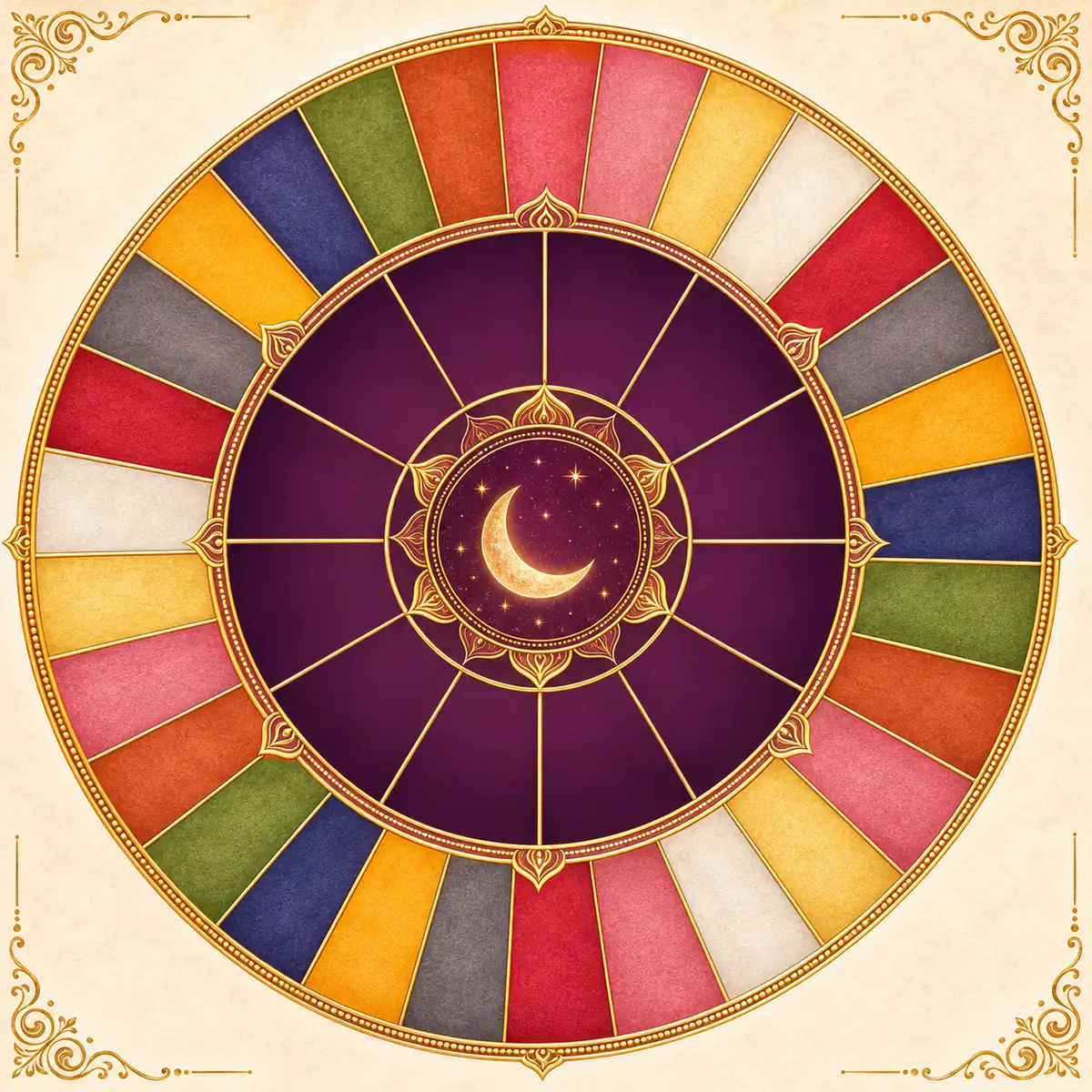
360° ÷ 27 = 13°20′ of the zodiac per nakshatra.
Each nakshatra has 4 padas of 3°20′, and 27 × 4 = 108. This is one reason 108 is sacred, and why a mala has 108 beads.
Each rashi (30°) holds 2¼ nakshatras, or exactly 9 padas.
The 27 nakshatras list in order (master table)
Tap or click any nakshatra on the wheel to see its meaning, lord, deity, gana and name letters. Tap a planet below the wheel to highlight the three nakshatras it rules.
All degrees are sidereal (nirayana, Lahiri ayanamsa), which is the standard used in Indian panchangs and kundlis. Use the search and filters to narrow both tables below.
Showing all 27 nakshatras
| # | Nakshatra | Meaning | Zodiac span | Rashi | Ruling planet | Deity | Symbol |
|---|---|---|---|---|---|---|---|
| 1 | Ashwini | Horse-woman / born of a horse | Aries 0°00′–13°20′ | Mesha | Ketu | Ashwini Kumaras | Horse’s head |
| 2 | Bharani | The bearer | Aries 13°20′–26°40′ | Mesha | Venus | Yama | Yoni (womb) |
| 3 | Krittika | The cutter (the Pleiades) | Aries 26°40′–Taurus 10°00′ | Mesha / Vrishabh | Sun | Agni | Razor / flame |
| 4 | Rohini | The red one | Taurus 10°00′–23°20′ | Vrishabh | Moon | Brahma (Prajapati) | Chariot / cart |
| 5 | Mrigashira | The deer’s head | Taurus 23°20′–Gemini 6°40′ | Vrishabh / Mithun | Mars | Soma | Deer’s head |
| 6 | Ardra | The moist one | Gemini 6°40′–20°00′ | Mithun | Rahu | Rudra | Teardrop |
| 7 | Punarvasu | Return of the light / restorer | Gemini 20°00′–Cancer 3°20′ | Mithun / Karka | Jupiter | Aditi | Bow and quiver |
| 8 | Pushya | The nourisher | Cancer 3°20′–16°40′ | Karka | Saturn | Brihaspati | Cow’s udder |
| 9 | Ashlesha | The embrace | Cancer 16°40′–30°00′ | Karka | Mercury | Nagas (serpents) | Coiled serpent |
| 10 | Magha | The great / the bountiful | Leo 0°00′–13°20′ | Simha | Ketu | Pitrs (ancestors) | Royal throne |
| 11 | Purva Phalguni | The former reddish one | Leo 13°20′–26°40′ | Simha | Venus | Bhaga | Front legs of a bed |
| 12 | Uttara Phalguni | The latter reddish one | Leo 26°40′–Virgo 10°00′ | Simha / Kanya | Sun | Aryaman | Back legs of a bed |
| 13 | Hasta | The hand | Virgo 10°00′–23°20′ | Kanya | Moon | Savitar (Sun) | Open hand |
| 14 | Chitra | The bright one | Virgo 23°20′–Libra 6°40′ | Kanya / Tula | Mars | Tvashtar / Vishwakarma | Shining jewel |
| 15 | Swati | The independent one / sword | Libra 6°40′–20°00′ | Tula | Rahu | Vayu | Young plant in the wind |
| 16 | Vishakha | Forked / with branches | Libra 20°00′–Scorpio 3°20′ | Tula / Vrishchik | Jupiter | Indra and Agni | Triumphal arch |
| 17 | Anuradha | Following Radha (success) | Scorpio 3°20′–16°40′ | Vrishchik | Saturn | Mitra | Lotus |
| 18 | Jyeshtha | The eldest | Scorpio 16°40′–30°00′ | Vrishchik | Mercury | Indra | Circular amulet / umbrella |
| 19 | Mula | The root | Sagittarius 0°00′–13°20′ | Dhanu | Ketu | Nirriti | Bunch of roots |
| 20 | Purva Ashadha | The former invincible one | Sagittarius 13°20′–26°40′ | Dhanu | Venus | Apas (waters) | Elephant tusk / fan |
| 21 | Uttara Ashadha | The latter invincible one | Sagittarius 26°40′–Capricorn 10°00′ | Dhanu / Makar | Sun | Vishvadevas | Elephant tusk / small bed |
| 22 | Shravana | Hearing | Capricorn 10°00′–23°20′ | Makar | Moon | Vishnu | Ear / three footprints |
| 23 | Dhanishta | The wealthiest / most famous | Capricorn 23°20′–Aquarius 6°40′ | Makar / Kumbh | Mars | Ashta Vasus | Drum (damaru) |
| 24 | Shatabhisha | A hundred physicians | Aquarius 6°40′–20°00′ | Kumbh | Rahu | Varuna | Empty circle |
| 25 | Purva Bhadrapada | The former lucky feet | Aquarius 20°00′–Pisces 3°20′ | Kumbh / Meen | Jupiter | Aja Ekapada | Front legs of a funeral cot |
| 26 | Uttara Bhadrapada | The latter lucky feet | Pisces 3°20′–16°40′ | Meen | Saturn | Ahirbudhnya | Back legs of a funeral cot / twins |
| 27 | Revati | The wealthy / prosperous | Pisces 16°40′–30°00′ | Meen | Mercury | Pushan | Pair of fish / drum |
Meanings are translated differently (Swati as “the self-going” or “sword”, Dhanishta as “wealthiest” or “most famous”). Symbols often have two or more traditional forms. The planets, deities and degrees above are standard across classical texts.
Gana, yoni, nadi and name letters for all 27 nakshatras
These are the details used in Kundli matching (Ashta Koota) and for choosing baby names. Most nakshatra list pages leave them out.
| # | Nakshatra | Gana | Yoni (animal) | Nadi | Name letters (padas 1–4) |
|---|---|---|---|---|---|
| 1 | Ashwini | Deva | Horse (M) | Adi | Chu, Che, Cho, La |
| 2 | Bharani | Manushya | Elephant (M) | Madhya | Li, Lu, Le, Lo |
| 3 | Krittika | Rakshasa | Goat (F) | Antya | A, I, U, E |
| 4 | Rohini | Manushya | Serpent (M) | Antya | O, Va, Vi, Vu |
| 5 | Mrigashira | Deva | Serpent (F) | Madhya | Ve, Vo, Ka, Ki |
| 6 | Ardra | Manushya | Dog (F) | Adi | Ku, Gha, Ng, Chha |
| 7 | Punarvasu | Deva | Cat (F) | Adi | Ke, Ko, Ha, Hi |
| 8 | Pushya | Deva | Goat (M) | Madhya | Hu, He, Ho, Da |
| 9 | Ashlesha | Rakshasa | Cat (M) | Antya | Di, Du, De, Do |
| 10 | Magha | Rakshasa | Rat (M) | Antya | Ma, Mi, Mu, Me |
| 11 | Purva Phalguni | Manushya | Rat (F) | Madhya | Mo, Ta, Ti, Tu |
| 12 | Uttara Phalguni | Manushya | Cow (M) | Adi | Te, To, Pa, Pi |
| 13 | Hasta | Deva | Buffalo (F) | Adi | Pu, Sha, Na, Tha |
| 14 | Chitra | Rakshasa | Tiger (F) | Madhya | Pe, Po, Ra, Ri |
| 15 | Swati | Deva | Buffalo (M) | Antya | Ru, Re, Ro, Ta |
| 16 | Vishakha | Rakshasa | Tiger (M) | Antya | Ti, Tu, Te, To |
| 17 | Anuradha | Deva | Deer (F) | Madhya | Na, Ni, Nu, Ne |
| 18 | Jyeshtha | Rakshasa | Deer (M) | Adi | No, Ya, Yi, Yu |
| 19 | Mula | Rakshasa | Dog (M) | Adi | Ye, Yo, Bha, Bhi |
| 20 | Purva Ashadha | Manushya | Monkey (M) | Madhya | Bhu, Dha, Pha, Dha |
| 21 | Uttara Ashadha | Manushya | Mongoose | Antya | Bhe, Bho, Ja, Ji |
| 22 | Shravana | Deva | Monkey (F) | Antya | Ju/Khi, Je/Khu, Jo/Khe, Gha/Kho |
| 23 | Dhanishta | Rakshasa | Lion (F) | Madhya | Ga, Gi, Gu, Ge |
| 24 | Shatabhisha | Rakshasa | Horse (F) | Adi | Go, Sa, Si, Su |
| 25 | Purva Bhadrapada | Manushya | Lion (M) | Adi | Se, So, Da, Di |
| 26 | Uttara Bhadrapada | Manushya | Cow (F) | Madhya | Du, Tha, Jha, Na |
| 27 | Revati | Deva | Elephant (F) | Antya | De, Do, Cha, Chi |
How to read this:
- Gana (temperament): there are 9 nakshatras in each of Deva (divine, gentle), Manushya (human, balanced) and Rakshasa (intense, fierce). “Rakshasa” doesn’t mean evil. It means strong-willed and self-protective. Same-gana couples score highest in matching.
- Yoni (instinct and physical compatibility): 14 animals, each with a male and female nakshatra. Matching yonis score best. “Enemy” pairs such as cat–rat, cow–tiger, dog–deer, horse–buffalo, lion–elephant, monkey–goat and serpent–mongoose score lowest.
- Nadi (constitution): Adi (Vata), Madhya (Pitta) and Antya (Kapha). Partners with the same nadi get Nadi Dosha, the most heavily weighted factor (8 of 36 points).
Nakshatras grouped by ruling planet
The ruling planets repeat in a fixed cycle of nine. This cycle is the basis of the Vimshottari Dasha system described in Brihat Parashara Hora Shastra, which decides which planetary period you’re born into.
| Planet | Its 3 nakshatras | Mahadasha length |
|---|---|---|
| Ketu | Ashwini, Magha, Mula | 7 years |
| Venus (Shukra) | Bharani, Purva Phalguni, Purva Ashadha | 20 years |
| Sun (Surya) | Krittika, Uttara Phalguni, Uttara Ashadha | 6 years |
| Moon (Chandra) | Rohini, Hasta, Shravana | 10 years |
| Mars (Mangal) | Mrigashira, Chitra, Dhanishta | 7 years |
| Rahu | Ardra, Swati, Shatabhisha | 18 years |
| Jupiter (Guru) | Punarvasu, Vishakha, Purva Bhadrapada | 16 years |
| Saturn (Shani) | Pushya, Anuradha, Uttara Bhadrapada | 19 years |
| Mercury (Budh) | Ashlesha, Jyeshtha, Revati | 17 years |
Total: 120 years. If you were born with the Moon in, say, Rohini, your life starts in the Moon’s Mahadasha. How much of it remains depends on how far the Moon had moved through Rohini at birth. Running a difficult Rahu or Ketu period? See my guide to Rahu and Ketu in astrology. For Saturn’s three nakshatras, the traditional bead is the 7 Mukhi Rudraksha.
All 27 nakshatras explained: meaning and traits
A quick profile of each nakshatra: what it means, which rashi it falls in, and its core nature. These are tendencies. Your full chart always adds more detail.
1. Ashwini Nakshatra (Aries)
Lord: Ketu · Deity: Ashwini Kumaras, the divine physicians. Fast, pioneering and youthful. Ashwini natives start things quickly, love speed and have a natural gift for healing and first aid. Best at medicine, sports and emergency work. Their lesson is patience.
2. Bharani Nakshatra (Aries)
Lord: Venus · Deity: Yama. The star of birth, death and restraint. Bharani people are intense, honest and able to carry heavy responsibilities. They are creative and sensual, with strong willpower. Good at law, finance, the arts and transformational work.
3. Krittika Nakshatra (Aries / Taurus)
Lord: Sun · Deity: Agni. The cutting flame. Krittika natives are sharp, direct and protective, with high standards and a temper to match. Natural leaders, critics, chefs and teachers. They cut through confusion.
4. Rohini Nakshatra (Taurus)
Lord: Moon · Deity: Brahma. The Moon’s favourite star. Rohini is beautiful, creative, sensual and fertile, with a love of comfort and luxury. Great with art, fashion, agriculture, food and design. The lesson is to avoid possessiveness.
5. Mrigashira Nakshatra (Taurus / Gemini)
Lord: Mars · Deity: Soma. The searching deer. Curious, gentle, restless and always seeking. Mrigashira natives make good researchers, writers, travellers and teachers. They may struggle to settle on one path.
6. Ardra Nakshatra (Gemini)
Lord: Rahu · Deity: Rudra. The storm and the teardrop. Ardra brings intense intellect, emotional depth and the ability to rebuild after destruction. Strong in technology, research, science and crisis management.
7. Punarvasu Nakshatra (Gemini / Cancer)
Lord: Jupiter · Deity: Aditi. The return of light. Optimistic, forgiving, spiritual and home-loving. Punarvasu natives bounce back from setbacks. Good teachers, counsellors, writers and travellers.
8. Pushya Nakshatra (Cancer)
Lord: Saturn · Deity: Brihaspati. The nourisher, considered the most auspicious nakshatra for new beginnings. Caring, responsible and traditional. Read my full guide: Pushya Nakshatra traits, career, marriage and dates.
9. Ashlesha Nakshatra (Cancer)
Lord: Mercury · Deity: the Nagas. The coiled serpent. Ashlesha natives are perceptive, strategic, magnetic and secretive, with deep psychological insight. Strong in psychology, politics, research and the occult. Ashlesha is a Gandmool nakshatra.
10. Magha Nakshatra (Leo)
Lord: Ketu · Deity: the Pitrs (ancestors). The royal throne. Magha brings dignity, leadership, pride and a deep respect for lineage and tradition. Natural in government, management and heritage roles. A Gandmool nakshatra.
11. Purva Phalguni Nakshatra (Leo)
Lord: Venus · Deity: Bhaga. The star of pleasure and rest. Charming, generous, creative and fond of romance and celebration. Good in the arts, entertainment, hospitality and events.
12. Uttara Phalguni Nakshatra (Leo / Virgo)
Lord: Sun · Deity: Aryaman, the god of contracts and friendship. Reliable, kind and committed. The star of marriage and partnership. Strong in administration, HR, social work and public service.
13. Hasta Nakshatra (Virgo)
Lord: Moon · Deity: Savitar. The skilled hand. Clever, witty and good with their hands, Hasta natives are excellent craftspeople, healers, writers and business people. They manifest ideas into reality.
14. Chitra Nakshatra (Virgo / Libra)
Lord: Mars · Deity: Vishwakarma, the divine architect. The bright jewel. Stylish, artistic and ambitious. Chitra natives love design, architecture, fashion, jewellery and engineering.
15. Swati Nakshatra (Libra)
Lord: Rahu · Deity: Vayu. The young shoot moved by the wind. Independent, flexible, diplomatic and business-minded. Swati natives thrive in trade, travel, law and anything that needs freedom.
16. Vishakha Nakshatra (Libra / Scorpio)
Lord: Jupiter · Deity: Indra and Agni. The forked branch and triumphal arch. Goal-driven, determined and competitive. Vishakha natives keep going until they win. Strong in politics, research, sales and leadership.
17. Anuradha Nakshatra (Scorpio)
Lord: Saturn · Deity: Mitra. The lotus that grows in mud. Loyal, devoted and good at friendship and teamwork, with success that comes through cooperation and persistence. Good in management, astrology, travel and international work.
18. Jyeshtha Nakshatra (Scorpio)
Lord: Mercury · Deity: Indra. The eldest. Protective, responsible, proud and resourceful, often carrying family burdens. Strong in leadership, defence, administration and strategy. A Gandmool nakshatra.
19. Mula Nakshatra (Sagittarius)
Lord: Ketu · Deity: Nirriti. The root. Mula natives dig to the bottom of everything: philosophical, investigative and spiritually intense, sometimes through upheaval. Good at research, medicine (especially herbal), philosophy and spirituality. A Gandmool nakshatra.
20. Purva Ashadha Nakshatra (Sagittarius)
Lord: Venus · Deity: Apas (the waters). The early victory. Confident, persuasive, idealistic and hard to defeat. Strong in law, media, shipping, teaching and motivational work.
21. Uttara Ashadha Nakshatra (Sagittarius / Capricorn)
Lord: Sun · Deity: the Vishvadevas. The final, lasting victory. Ethical, patient and responsible, with success that comes later but endures. Strong in government, law, leadership and public service.
22. Shravana Nakshatra (Capricorn)
Lord: Moon · Deity: Vishnu. Hearing. Shravana natives are good listeners, lifelong learners and keepers of knowledge and tradition. Excellent teachers, counsellors, speakers and media professionals.
23. Dhanishta Nakshatra (Capricorn / Aquarius)
Lord: Mars · Deity: the Ashta Vasus. The drum, a symbol of rhythm and wealth. Musical, generous, ambitious and wealth-attracting. Good in music, real estate, sports and group leadership.
24. Shatabhisha Nakshatra (Aquarius)
Lord: Rahu · Deity: Varuna. A hundred healers. Mysterious, independent, scientific and healing-oriented. Often a loner. Strong in medicine, technology, astrology, research and alternative healing.
25. Purva Bhadrapada Nakshatra (Aquarius / Pisces)
Lord: Jupiter · Deity: Aja Ekapada. The fiery first half of the funeral cot. Idealistic, intense, philosophical and capable of great sacrifice. Good in spirituality, research, activism and occult studies.
26. Uttara Bhadrapada Nakshatra (Pisces)
Lord: Saturn · Deity: Ahirbudhnya, the serpent of the deep. Calm, wise, disciplined and compassionate, with deep emotional control. Strong in counselling, charity, research and spiritual teaching.
27. Revati Nakshatra (Pisces)
Lord: Mercury · Deity: Pushan, the protector of travellers. The last nakshatra. Gentle, kind, creative and protective of the weak. Good in the arts, travel, caregiving and spiritual guidance. A Gandmool nakshatra.
Abhijit: the 28th nakshatra
Older Vedic texts list 28 nakshatras. The extra one is Abhijit (“the invincible”), associated with the bright star Vega. It lies within Capricorn from about 6°40′ to 10°53′20″, overlapping the end of Uttara Ashadha and the start of Shravana.
Abhijit is not used in the Vimshottari dasha system or in Kundli matching, which is why the standard list has 27. It is still used in muhurta. The daily Abhijit Muhurta, roughly 24 minutes either side of local midday, is considered auspicious for most work.
Gandmool nakshatras
Six nakshatras sit at the junction between a water sign and a fire sign. These junctions are called gandanta. Births in these nakshatras are traditionally called Gandmool (Gand Mool):
| Gandmool nakshatra | Junction |
|---|---|
| Ashwini | Pisces → Aries |
| Ashlesha | Cancer → Leo |
| Magha | Cancer → Leo |
| Jyeshtha | Scorpio → Sagittarius |
| Mula | Scorpio → Sagittarius |
| Revati | Pisces → Aries |
Traditionally, a Gandmool shanti puja is done for a baby born in these nakshatras, usually on the 27th day after birth, when the Moon returns to the same nakshatra. In my experience, a Gandmool birth is not a reason to fear. It is a sign of a strong, transformative chart. The traditional effects apply mainly to particular padas, and they depend on the rest of the chart.
Nakshatra vs rashi: what’s the difference?
| Rashi (Moon sign) | Nakshatra (birth star) | |
|---|---|---|
| Number | 12 | 27 |
| Size | 30° each | 13°20′ each |
| Based on | Sun’s yearly path, divided into 12 | Moon’s monthly path, divided into 27 |
| Tells you | Broad temperament and the life areas affected | Finer detail: instinct, emotional nature, dasha sequence |
| Used for | Transits (Sade Sati, Jupiter transit), horoscopes | Dasha periods, Kundli matching, naming, muhurta |
Think of the rashi as the neighbourhood and the nakshatra as the house where your Moon lives. Two people with the same Moon sign can have very different natures if their nakshatras differ. A Cancer Moon in Punarvasu is not the same as one in Ashlesha.
Rashi and nakshatra list
| Rashi | Nakshatras (with padas) |
|---|---|
| Mesha (Aries) | Ashwini (1–4), Bharani (1–4), Krittika (1) |
| Vrishabh (Taurus) | Krittika (2–4), Rohini (1–4), Mrigashira (1–2) |
| Mithun (Gemini) | Mrigashira (3–4), Ardra (1–4), Punarvasu (1–3) |
| Karka (Cancer) | Punarvasu (4), Pushya (1–4), Ashlesha (1–4) |
| Simha (Leo) | Magha (1–4), Purva Phalguni (1–4), Uttara Phalguni (1) |
| Kanya (Virgo) | Uttara Phalguni (2–4), Hasta (1–4), Chitra (1–2) |
| Tula (Libra) | Chitra (3–4), Swati (1–4), Vishakha (1–3) |
| Vrishchik (Scorpio) | Vishakha (4), Anuradha (1–4), Jyeshtha (1–4) |
| Dhanu (Sagittarius) | Mula (1–4), Purva Ashadha (1–4), Uttara Ashadha (1) |
| Makar (Capricorn) | Uttara Ashadha (2–4), Shravana (1–4), Dhanishta (1–2) |
| Kumbh (Aquarius) | Dhanishta (3–4), Shatabhisha (1–4), Purva Bhadrapada (1–3) |
| Meen (Pisces) | Purva Bhadrapada (4), Uttara Bhadrapada (1–4), Revati (1–4) |
How to find your nakshatra
You need your date, exact time and place of birth. The Moon changes nakshatra about once a day, so the date alone isn’t enough.
The easy way: look at your kundli. Your Janma Nakshatra is listed next to the Moon, often as “Nakshatra: Rohini, Pada 2”. Any reputable panchang or kundli software will calculate it.
The manual way (if you know your Moon’s sidereal degree):
- Convert the Moon’s position to total degrees from 0° Aries. For example, Moon at 12° Cancer = 90° + 12° = 102°.
- Divide by 13.333 (13°20′): 102 ÷ 13.333 = 7.65.
- Round up to the next whole number: 8, which is Pushya.
- For the pada, look at the remainder: 0.65 × 4 = 2.6, so round up to pada 3.
Make sure the degree is sidereal (Lahiri ayanamsa), not tropical (Western). The two differ by about 24°, which can shift you by almost two nakshatras.
If you’d like me to read your nakshatra with your full chart, I do this in every Vedic astrology reading.
How nakshatras are used in real life
The first letter of the name traditionally follows the pada syllable of the birth nakshatra (see the name letters table).
Gana, Yoni, Nadi and Tara are all calculated from the two partners’ nakshatras. I explain the Manglik factor separately in my Manglik Dosh guide.
Each nakshatra has a nature (fixed, movable, swift, soft, fierce and so on) that makes it good for certain actions. Pushya is the best-known example. Rohini, Mrigashira and Revati are among those favoured for weddings.
Your birth nakshatra decides your Vimshottari dasha sequence, which most Vedic astrologers use as their main timing tool.
“Aaj kaun sa nakshatra hai?” The day’s nakshatra is part of the five-limbed panchang, along with tithi, vara, yoga and karana.
Worshipping your nakshatra’s deity, chanting its mantra and caring for its tree are gentle, chart-safe remedies.
Which nakshatra is best? There is no single “best” nakshatra for a birth. Each has strengths and challenges. For muhurta, Pushya is traditionally considered the most auspicious for new beginnings, and Rohini, Uttara Phalguni, Hasta and Revati are among the most favoured for marriage.
How I use nakshatras in a reading
In a consultation, the nakshatra is usually the first thing I look at, before planets and houses. This is the order I work in:
- Janma nakshatra and pada. This tells me the person’s emotional nature and instinct, often more accurately than the Moon sign.
- Lagna nakshatra. The nakshatra rising at birth shows how the person approaches the world. When the Moon and Lagna nakshatras pull in different directions, that tension is often what the client has come to talk about.
- Nakshatra lord’s condition. If someone is born in Rohini, I look at where the Moon sits and how strong it is, because the lord delivers the nakshatra’s promise.
- Current dasha. I check which planet’s period is running and which nakshatras that planet occupies. This tells me which themes are “switched on” right now.
- Tara Bala for timing. When a client asks “when should I start?”, I count from their birth nakshatra to the day’s nakshatra. This is the simplest personal muhurta check, and few people know it exists.
From my readings
Two sisters came to me puzzled: same Moon sign (Leo), born three years apart, yet completely different. One was a confident, ancestry-proud Magha. The other was a fun-loving, artistic Purva Phalguni. Seeing their nakshatras side by side made their differences make sense in minutes, and it changed how they related to each other. That’s why I always read the nakshatra, not just the sign.
Composite of several readings; details changed for privacy.
27 नक्षत्र (हिंदी में सारांश)
वैदिक ज्योतिष में कुल 27 नक्षत्र होते हैं और प्रत्येक नक्षत्र 13°20′ का होता है। क्रम से 27 नक्षत्रों के नाम हैं: अश्विनी, भरणी, कृत्तिका, रोहिणी, मृगशिरा, आर्द्रा, पुनर्वसु, पुष्य, आश्लेषा, मघा, पूर्वा फाल्गुनी, उत्तरा फाल्गुनी, हस्त, चित्रा, स्वाति, विशाखा, अनुराधा, ज्येष्ठा, मूल, पूर्वाषाढ़ा, उत्तराषाढ़ा, श्रवण, धनिष्ठा, शतभिषा, पूर्वा भाद्रपद, उत्तरा भाद्रपद और रेवती। हर नक्षत्र के चार चरण होते हैं, कुल 108 चरण। हर नक्षत्र का एक स्वामी ग्रह, देवता और प्रतीक होता है। 28वां नक्षत्र अभिजीत है, जिसे दशा और कुंडली मिलान में नहीं गिना जाता। अश्विनी, आश्लेषा, मघा, ज्येष्ठा, मूल और रेवती गंडमूल नक्षत्र हैं। आपका जन्म नक्षत्र वह है जिसमें जन्म के समय चंद्रमा था।
Conclusion
The 27 nakshatras are the finest layer of the Vedic chart. They are older than the zodiac signs and far more personal. Knowing your birth nakshatra tells you your dasha sequence, your natural temperament (gana), your instinctive needs (yoni), the letters for your name and your compatibility with others. Use the tables above as a reference, and read the individual nakshatra guides to go deeper, starting with Pushya Nakshatra.
To understand what your nakshatra means alongside your Lagna, planets and current dasha, book a Kundli reading.
What is your nakshatra telling you right now?
Send me your birth date, time and place, and I’ll tell you your nakshatra, pada and what it means for you right now.
FAQs
How many nakshatras are there?
There are 27 nakshatras in Vedic astrology, each covering 13°20′ of the zodiac. Older texts count 28 by including Abhijit, but Abhijit is not used in dashas or Kundli matching.
What are the 27 nakshatras in order?
Ashwini, Bharani, Krittika, Rohini, Mrigashira, Ardra, Punarvasu, Pushya, Ashlesha, Magha, Purva Phalguni, Uttara Phalguni, Hasta, Chitra, Swati, Vishakha, Anuradha, Jyeshtha, Mula, Purva Ashadha, Uttara Ashadha, Shravana, Dhanishta, Shatabhisha, Purva Bhadrapada, Uttara Bhadrapada and Revati.
Which is the first nakshatra?
Ashwini is the first nakshatra. It spans 0° to 13°20′ of Aries (Mesha) and is ruled by Ketu.
What is my nakshatra by date of birth?
Your nakshatra depends on your date, exact time and place of birth, because the Moon changes nakshatra about once a day. It is the nakshatra the Moon occupied at your birth, and it is listed next to the Moon in your kundli.
Which nakshatras belong to which rashi?
Each rashi holds 2¼ nakshatras. For example, Mesha (Aries) contains Ashwini, Bharani and the first pada of Krittika. See the rashi and nakshatra table above for all 12 signs.
What are the 9 planets and their nakshatras?
Ketu rules Ashwini, Magha and Mula. Venus rules Bharani, Purva Phalguni and Purva Ashadha. The Sun rules Krittika, Uttara Phalguni and Uttara Ashadha. The Moon rules Rohini, Hasta and Shravana. Mars rules Mrigashira, Chitra and Dhanishta. Rahu rules Ardra, Swati and Shatabhisha. Jupiter rules Punarvasu, Vishakha and Purva Bhadrapada. Saturn rules Pushya, Anuradha and Uttara Bhadrapada. Mercury rules Ashlesha, Jyeshtha and Revati.
Which nakshatra is the best?
No birth nakshatra is better than another, since each has its own strengths. For auspicious timing, Pushya is traditionally considered the best nakshatra for new beginnings and purchases.
What are Gandmool nakshatras?
Ashwini, Ashlesha, Magha, Jyeshtha, Mula and Revati are Gandmool nakshatras, because they sit at water-fire sign junctions. A Gandmool shanti puja is traditionally done for babies born in them.
What is the difference between nakshatra and rashi?
A rashi is one of 12 zodiac signs of 30° each. A nakshatra is one of 27 lunar mansions of 13°20′ each. The nakshatra gives finer detail and decides your dasha sequence and Kundli matching scores.
What are Deva, Manushya and Rakshasa gana nakshatras?
Deva: Ashwini, Mrigashira, Punarvasu, Pushya, Hasta, Swati, Anuradha, Shravana, Revati. Manushya: Bharani, Rohini, Ardra, Purva Phalguni, Uttara Phalguni, Purva Ashadha, Uttara Ashadha, Purva Bhadrapada, Uttara Bhadrapada. Rakshasa: Krittika, Ashlesha, Magha, Chitra, Vishakha, Jyeshtha, Mula, Dhanishta, Shatabhisha.
Why are there 108 padas?
Each of the 27 nakshatras has 4 padas (quarters), and 27 × 4 = 108. This is one reason 108 is considered sacred in Hindu tradition.
Spiritual and astrological guidance is for personal reflection. It is not a substitute for qualified medical, legal, financial or psychological advice.