Rahu and Ketu in Astrology: Meaning, Effects in Each House and Remedies
 By Monica Kapoor · Vedic astrologer & tarot mentor · Masters in Vedic Numerology · 15+ years of practice
Rahu and Ketu are the two lunar nodes in Vedic astrology: the points where the Moon’s path crosses the Sun’s. They are always exactly opposite each other. Rahu (north node) shows what you crave and chase in this life. Ketu (south node) shows what you already mastered and now feel detached from. Together they mark your karmic axis.
Most people first hear about Rahu and Ketu when something goes wrong. A sudden job loss, a marriage that keeps getting delayed, a strange fear that won’t go away, and then someone says, “It’s Rahu.” So the two names arrive already wrapped in dread.
In my readings I see them very differently. Rahu is the reason many people become ambitious, foreign-settled, famous or rich. Ketu is the reason others become deeply intuitive, spiritual or brilliant in research. They are not villains. They are the two ends of one line in your chart, and once you know where that line falls, a lot of your life starts to make sense. In this guide I’ll explain what Rahu and Ketu are, what they do in each pair of houses, how their mahadasha works, what the December 2026 transit means, and the remedies I actually trust.
What are Rahu and Ketu?
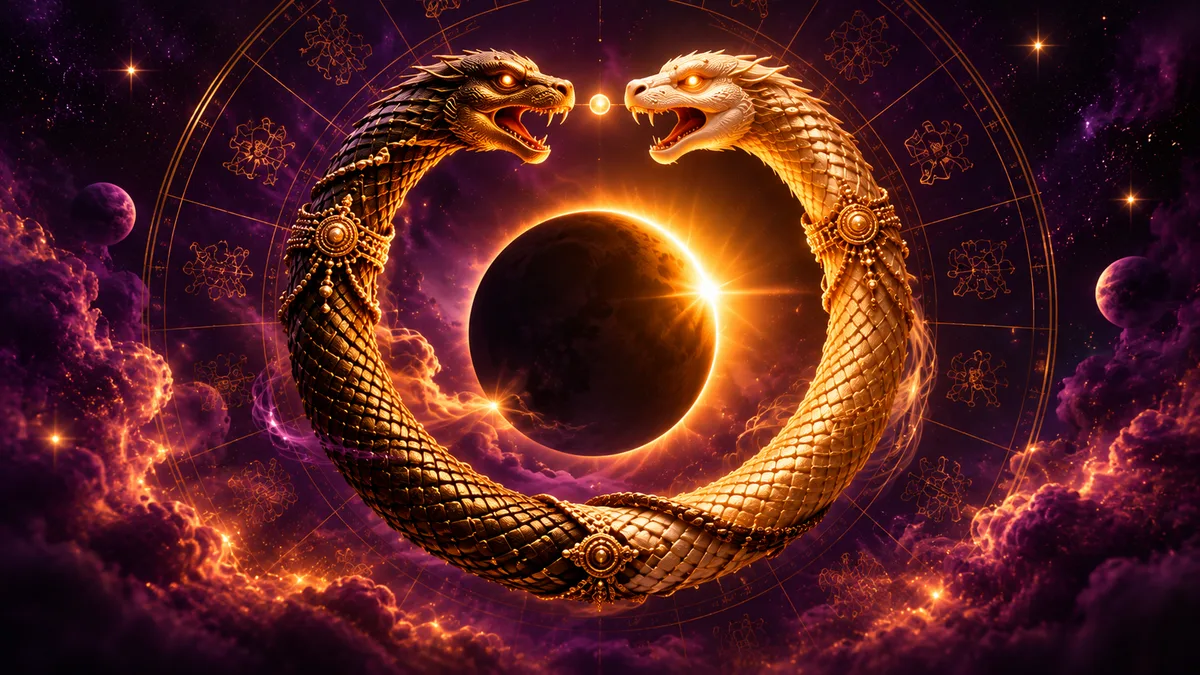
Rahu and Ketu are two of the nine grahas (Navagraha) in Vedic astrology. Unlike the Sun, Moon or Saturn, they have no physical body. That is why they are called chhaya grahas, or shadow planets. They are mathematical points in the sky, yet in a kundli they are often the most powerful influences of all.
Three things define them:
- They always sit opposite each other. If Rahu is in your 7th house, Ketu is in your 1st. If Rahu is in Aries, Ketu is in Libra. You can never read one without the other.
- They always move backwards (retrograde) through the zodiac, spending about 18 months in each sign.
- They act like the planet that rules the sign they sit in. Rahu in Capricorn borrows Saturn’s flavour. Ketu in Cancer borrows the Moon’s. This is why the same Rahu placement behaves differently in two charts.
A simple way to remember them: Rahu is hunger, Ketu is fullness. Rahu points to what your soul wants to experience this time. Ketu points to what it has already had enough of.
Rahu and Ketu in astronomy: the lunar nodes
This part surprises many clients. Rahu and Ketu are not imaginary. They are real points that astronomers also track.
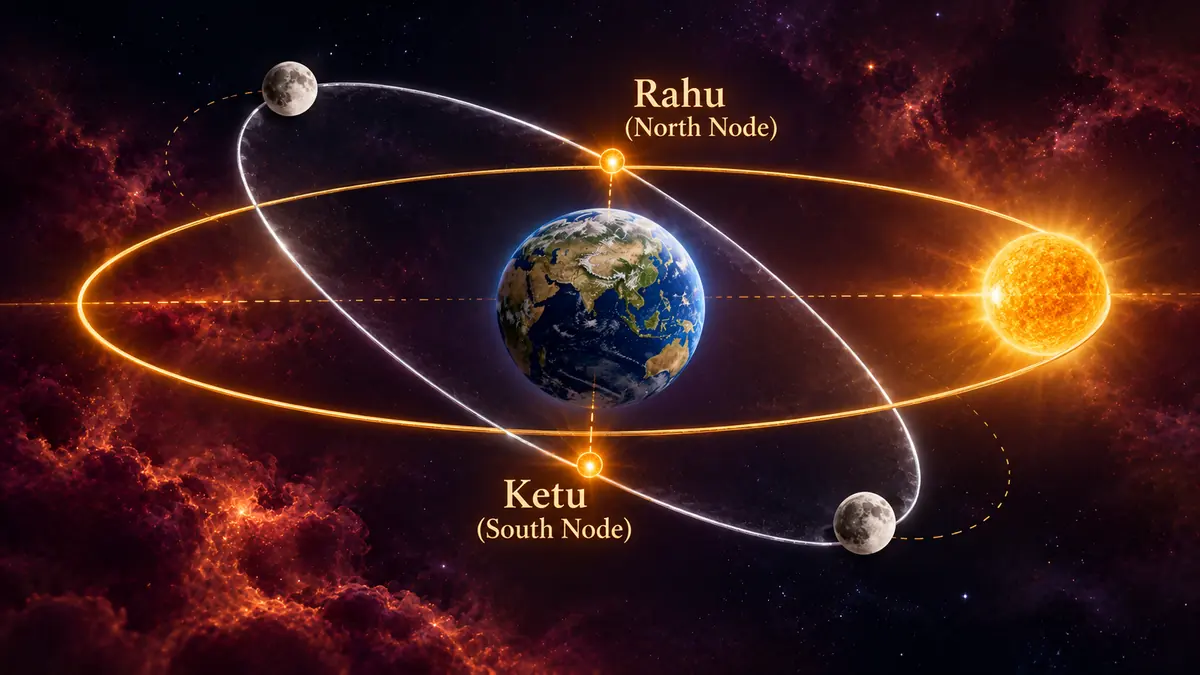
The Moon’s orbit around the Earth is tilted by about 5 degrees compared with the Sun’s apparent path (the ecliptic). The two paths cross at two points:
- Rahu is the north (ascending) node, where the Moon crosses going north.
- Ketu is the south (descending) node, where it crosses going south.
These crossing points slowly drift backwards and complete a full circle in about 18.6 years. Solar and lunar eclipses can only happen when the Sun and Moon are close to these nodes. That is the astronomical root of the old story that Rahu and Ketu “swallow” the Sun and Moon.
The story of Rahu and Ketu (Svarbhanu)
During the Samudra Manthan, the churning of the ocean, the devas and asuras together drew out amrit, the nectar of immortality. Lord Vishnu took the form of Mohini to serve it only to the devas. An asura named Svarbhanu disguised himself, sat between the Sun and the Moon, and drank a sip.
The Sun and Moon recognised him and told Vishnu, who cut off his head with the Sudarshan Chakra. But the amrit had already reached his throat, so both parts stayed alive. The head became Rahu and the headless body became Ketu. Their old grudge against the Sun and Moon is why eclipses are said to happen.
The story appears in the Mahabharata (Adi Parva) and the Bhagavata Purana, and an eclipse caused by Svarbhanu is already mentioned in the Rigveda. Astrologically the symbolism is exact: Rahu is a head with no body, all desire and no digestion. Ketu is a body with no head, all instinct and no ambition.
What is Rahu?
Rahu represents desire, obsession, ambition, illusion and the new. It rules things that are foreign, unconventional, modern or larger than life: technology, the internet, politics, media, research into hidden matters, foreign travel and sudden rise. A strong Rahu can make a person fearless and wildly successful. An afflicted Rahu brings confusion, addiction, anxiety, deception and “never enough”.
What is Ketu?
Ketu represents detachment, past-life skill, intuition, liberation (moksha) and loss. It gives sharp insight, healing ability, interest in mantra and spirituality, and talent in technical or research work done quietly. An afflicted Ketu brings confusion about direction, sudden separations, unexplained health issues and a feeling of “what’s the point?”.
Rahu and Ketu at a glance
| Rahu | Ketu | |
|---|---|---|
| Also called | North node, Dragon’s head | South node, Dragon’s tail |
| Key theme | Desire, ambition, the new | Detachment, past-life mastery, moksha |
| Nakshatras ruled | Ardra, Swati, Shatabhisha | Ashwini, Magha, Mula |
| Mahadasha | 18 years | 7 years |
| Time in each sign | About 18 months | About 18 months |
| Gemstone | Hessonite (Gomed) | Cat’s eye (Lehsunia) |
| Day | Saturday | Tuesday (some traditions: Thursday) |
| Deity for remedies | Goddess Durga | Lord Ganesha |
| Colours | Dark blue, black, smoky | Grey, smoky, multicoloured |
| Direction | South-west | North-west / south (texts vary) |
| Numerology number | 4 | 7 |
Rahu and Ketu in each house
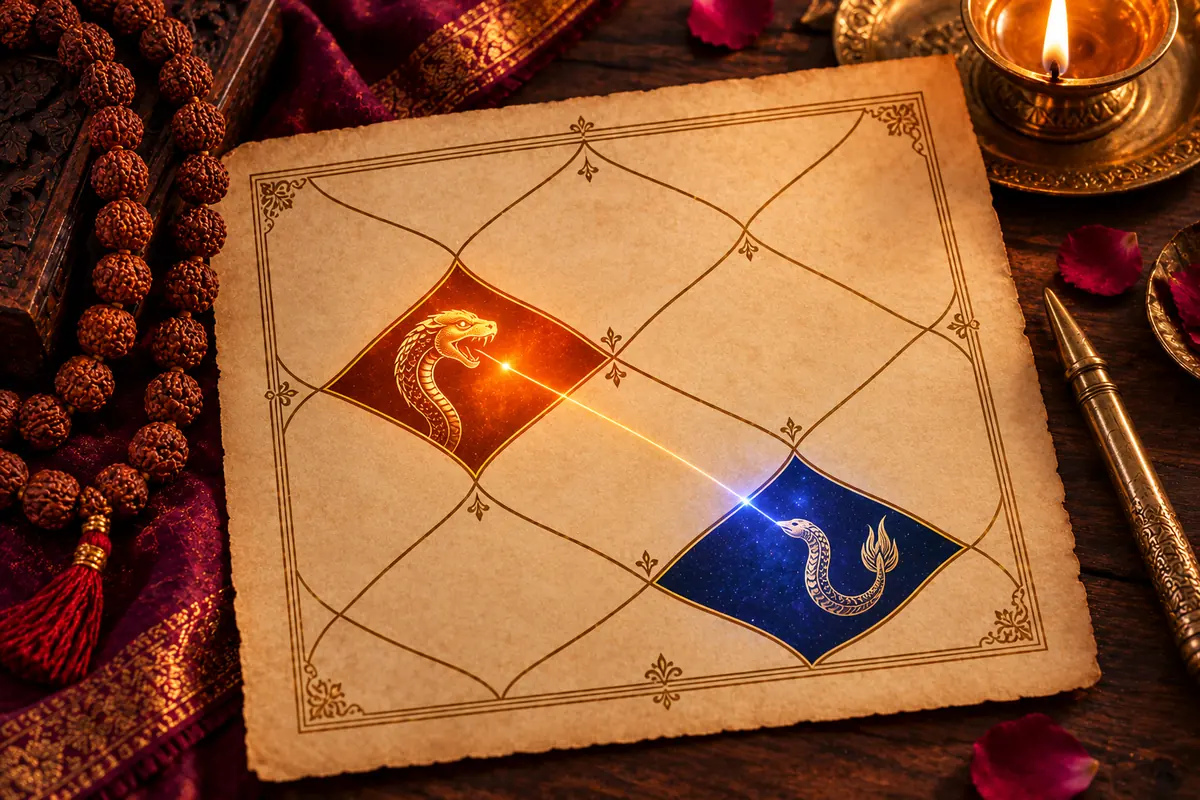
Because the two nodes are always opposite, they work on a pair of houses at once. Rahu shows where you over-reach. Ketu shows where you pull back. The result is a tug-of-war between two areas of life. Find the house of Rahu in your chart (counted from the lagna), and you automatically know Ketu’s.
| House | Rahu here | Ketu here |
|---|---|---|
| 1st | Strong personality, hungry for recognition, unusual looks or style | Low self-focus, spiritual, sometimes unsure of identity |
| 2nd | Drive to earn and accumulate; sharp or exaggerated speech | Indifference to wealth; family distance; blunt speech |
| 3rd | Courageous, bold in media and communication; one of Rahu’s best houses | Detached from siblings; quiet courage |
| 4th | Restless at home, frequent moves, property abroad | Emotional distance from mother or home; inner search |
| 5th | Unusual intelligence, speculation, love affairs; delays with children | Past-life wisdom, mantra siddhi; detachment in romance |
| 6th | Defeats enemies and competitors; excellent for service and law | Hidden health issues; healing ability |
| 7th | Unconventional or foreign spouse, strong desire for partnership, marriage tests | Detached or delayed partnership; spiritual spouse |
| 8th | Sudden events, research, occult, inheritance; anxiety | Strong intuition, interest in the occult; sudden changes handled calmly |
| 9th | Questions tradition and gurus; foreign higher studies | Born wisdom; distance from father or dogma |
| 10th | Big career ambition, fame, politics, tech; rise through unusual paths | Changes in career; works best behind the scenes |
| 11th | Large gains, wide network, fulfilment of desires; one of Rahu’s best houses | Few but deep friends; detachment from gains |
| 12th | Foreign settlement, spending, sleep issues; spiritual confusion | Moksha, meditation, liberation; one of Ketu’s best houses |
These are starting points, not verdicts. The sign, the planets with the nodes, their nakshatra and the running dasha all change the result.
Rahu in 7th house, Ketu in 1st house (and the reverse)
This is the self-versus-partner axis, and the one I am asked about most. With Rahu in the 7th house, you are pulled strongly toward relationships and public dealings. The spouse is often from a different background, caste, religion or country, and marriage can come with surprise or delay. Partnerships in business can be very profitable but need written agreements. With Ketu in the 7th house, you may feel oddly detached in marriage even when the partner is good, or marry later after one important ending. Neither placement denies marriage. If Mars is also involved, read my guide to Manglik Dosh, because the two are often confused in kundli matching.
Rahu in 8th house, Ketu in 2nd house (and the reverse)
Money versus transformation. Rahu in the 8th house gives a fascination with secrets, insurance, research, astrology and other people’s money. It can bring sudden gains and sudden losses, and needs care with health and risky ventures. Ketu in the 8th often gives natural intuition and calm in a crisis. Rahu in the 2nd makes you a strong earner and speaker. Just watch exaggeration.
Rahu in 3rd house, Ketu in 9th house (and the reverse)
Effort versus belief. Rahu in the 3rd is one of its happiest places: courage, writing, media, sales, short travel and self-made success. Ketu in the 9th gives an inner faith that doesn’t need rituals. Reversed, Rahu in the 9th questions tradition and often studies or settles abroad.
Rahu in 10th house, Ketu in 4th house (and the reverse)
Home versus career. Rahu in the 10th house is a classic placement for ambition and public rise, in politics, technology, media or foreign companies. Ketu in the 4th then makes home life feel unsettled or less important. Reversed, Rahu in the 4th brings property, vehicles and moves, but restlessness inside the home.
Rahu in 5th house, Ketu in 11th house (and the reverse)
Creativity versus gains. Rahu in the 11th is excellent for income, network and big wishes coming true. Rahu in the 5th house gives an unusual, research-minded intelligence and an interest in speculation. It can delay children or bring worry about them, so I always check the 5th lord and Jupiter before saying more.
Rahu in 12th house, Ketu in 6th house (and the reverse)
Service versus surrender. Rahu in the 6th defeats competitors and does well in law, medicine and service jobs. Ketu in the 12th is considered its finest house for spirituality and moksha. Reversed, Rahu in the 12th house often brings foreign settlement and high spending, and sometimes disturbed sleep.
Exaltation, debilitation and friendships
Rahu and Ketu don’t own signs in the classical scheme, so astrologers disagree about where they are strongest. You’ll see both views online, which is why so many readers get confused.
| View 1 (more common in North India) | View 2 (e.g. some Parashari commentaries) | |
|---|---|---|
| Rahu exalted | Taurus | Gemini |
| Rahu debilitated | Scorpio | Sagittarius |
| Ketu exalted | Scorpio | Sagittarius |
| Ketu debilitated | Taurus | Gemini |
In practice, I give more weight to the sign’s lord and the nodes’ conjunctions than to exaltation. Rahu generally behaves like Saturn and is friendly with Saturn, Mercury and Venus. Ketu behaves like Mars and is friendly with Mars and Jupiter. Both are uncomfortable with the Sun and Moon, which matches the eclipse story.
Rahu and Ketu mahadasha
In the Vimshottari dasha system, Rahu mahadasha lasts 18 years and Ketu mahadasha lasts 7 years. Rahu’s period comes after Mars and before Jupiter. Ketu’s comes after Mercury and before Venus.
Rahu mahadasha is often the most eventful period of a person’s life: a move abroad, a big career jump, a love marriage, a sudden loss, or all of these. Ketu mahadasha tends to strip things back. People change jobs, end relationships that no longer fit, turn spiritual, or suddenly become very good at one specialised skill.
Antardashas inside Rahu mahadasha
| Antardasha (sub-period) | Approx. length | Typical tone |
|---|---|---|
| Rahu–Rahu | 2 yrs 8 m 12 d | Most intense; new desires, confusion, big changes |
| Rahu–Jupiter | 2 yrs 4 m 24 d | Often relief: guidance, learning, children, marriage |
| Rahu–Saturn | 2 yrs 10 m 6 d | Hard work, delays, but solid results if disciplined |
| Rahu–Mercury | 2 yrs 6 m 18 d | Business, communication, tech, trade |
| Rahu–Ketu | 1 yr 0 m 18 d | Testing; sudden breaks, spiritual pull |
| Rahu–Venus | 3 yrs 0 m 0 d | Comfort, romance, luxury, money |
| Rahu–Sun | 0 yrs 10 m 24 d | Ego clashes with authority; health of father |
| Rahu–Moon | 1 yr 6 m 0 d | Emotional ups and downs, anxiety; mother |
| Rahu–Mars | 1 yr 0 m 18 d | Energy, property, disputes; drive carefully |
Ketu mahadasha follows the same pattern for 7 years, starting with Ketu–Ketu (about 4 months 27 days) and then Venus, Sun, Moon, Mars, Rahu, Jupiter, Saturn and Mercury.
How a dasha feels depends on where the node sits, its sign lord and the planets with it. A well-placed Rahu in the 3rd, 6th, 10th or 11th can make its 18 years the best of your life.
Rahu Ketu transit 2026: what changes on 5 December
Rahu moves from Aquarius into Capricorn and Ketu moves from Leo into Cancer on about 5 December 2026 (mean node), and they stay there until about mid-2028. Rahu and Ketu have been in Aquarius and Leo since 18 May 2025.
Some software uses the “true node” instead of the “mean node” and shows the change in late November 2026. Both methods are traditional. The difference is only a few days, so don’t let it worry you.
What the shift means in broad strokes:
- Rahu in Capricorn (Saturn’s sign): ambition through structure, government, infrastructure and long-term work. Shortcuts get exposed.
- Ketu in Cancer (the Moon’s sign): emotional detachment around home, mother and comfort zones. A pull towards inner peace over outer security.
- Signs that usually feel the change most: those where the nodes now fall in the 1st/7th, 4th/10th or 5th/11th from your Moon or lagna. Check your own chart rather than a sun-sign forecast.
Want to know which houses the December 2026 transit activates for you?
Send me your birth details. I’ll check where Rahu and Ketu sit in your kundli, your running dasha, and what the transit into Capricorn and Cancer means for your career, marriage and health.
Rahu, Ketu and Kaal Sarp Dosh
When all seven planets fall on one side of the Rahu–Ketu axis, hemmed in between the two nodes, the chart is said to have Kaal Sarp Dosh. It is named for the serpent (sarp) whose head and tail are Rahu and Ketu. The placement is often linked to struggle early in life followed by a strong rise. It is also widely over-diagnosed. Many traditional texts don’t even mention it, and a single planet outside the axis breaks it. Don’t panic if a website says you have it; have the chart checked properly.
Rahu and Ketu remedies (Rahu Ketu ke upay)
Remedies don’t remove a placement. They help you live its better side. I suggest starting with the simple, free ones and adding others only if a chart reading supports them.
1. Mantra
| Rahu | Ketu | |
|---|---|---|
| Beej mantra | ॐ भ्रां भ्रीं भ्रौं सः राहवे नमः Om Bhraam Bhreem Bhraum Sah Rahave Namah | ॐ स्रां स्रीं स्रौं सः केतवे नमः Om Sraam Sreem Sraum Sah Ketave Namah |
| Short mantra | Om Raam Rahave Namah | Om Kem Ketave Namah |
| Daily count | 108 (one mala) | 108 (one mala) |
| Best day | Saturday, evening | Tuesday |
Chant with a calm mind and correct pronunciation. Consistency for 40 days matters more than a large count on one day.
2. Daan (charity)
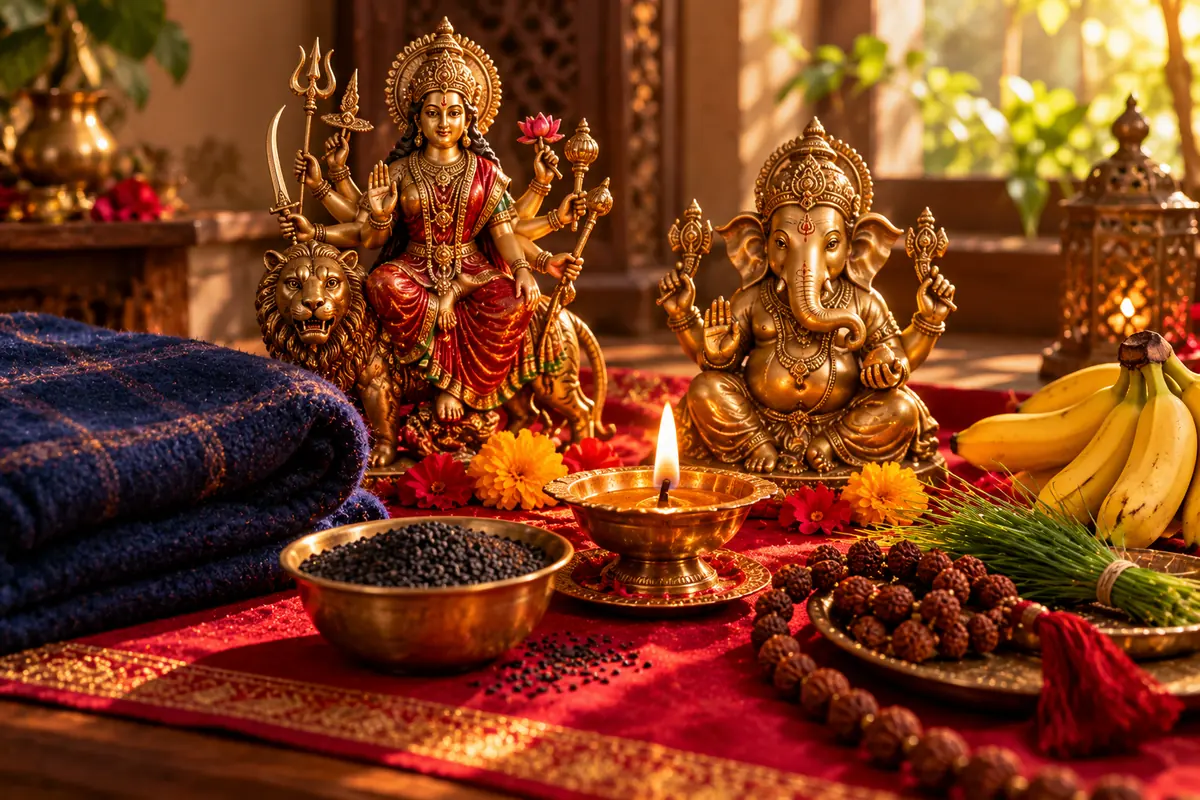
- Rahu: black sesame, black or blue blankets, mustard oil or coconut on Saturdays. Feed stray dogs.
- Ketu: a multicoloured or grey blanket, sesame or bananas on Tuesdays. Feed dogs, especially a black-and-white dog.
3. Worship
- Rahu: Durga Saptashati path or the Durga Chalisa, and Bhairav worship on Saturdays.
- Ketu: Ganesha puja, offering durva grass, and the Ganesha Atharvashirsha.
- For both: Mahamrityunjaya mantra during difficult dashas, and Shiva abhishek on Mondays. Structured rituals such as a navagraha shanti can be planned through my rituals and spiritual alignment service.
4. Lifestyle (the most underrated)
- Rahu grows with addiction, lies and shortcuts. Cutting alcohol, gambling and late-night screen habits is a real Rahu remedy.
- Ketu calms with routine, meditation and service. Ten minutes of silent meditation a day helps more than most rituals.
- Respect your maternal grandparents (Rahu) and paternal grandparents (Ketu) in tradition, and do shraddha with sincerity. In some charts Rahu and Ketu with the Sun point to Pitra Dosh.
5. Gemstones (only after a chart check)
Hessonite (Gomed) for Rahu and Cat’s eye (Lehsunia) for Ketu are powerful and fast-acting. Never wear them because a website or friend suggested it. If the node is badly placed for your lagna, the stone can make problems worse. Cat’s eye in particular is usually tested for a few days before it is worn permanently.
Myths about Rahu and Ketu
- “Rahu mahadasha means 18 bad years.” No. Many people have their biggest success in Rahu dasha. The Rahu–Jupiter and Rahu–Venus sub-periods are often very good.
- “Rahu is always bad and Ketu always brings loss.” Both give excellent results in the 3rd, 6th and 11th houses, and Ketu in the 12th is called a moksha placement.
- “Rahu kaal is the same as Rahu.” Rahu kaal is a daily 90-minute window used to avoid starting new work. It is a muhurta tool, not the position of Rahu in your chart.
- “Kaal Sarp Dosh ruins your life.” It is often wrongly diagnosed, and even when present it is linked with late but strong success.
- “Wear Gomed to fix Rahu.” A gemstone strengthens a planet. Strengthening a badly placed Rahu can backfire.
From my readings
When I read Rahu and Ketu, I follow the same order every time:
- Find the axis. Which pair of houses is involved, counted from the lagna and from the Moon?
- Check the sign lords. Rahu in Capricorn acts like Saturn, so I look at where Saturn sits and how strong it is.
- Look at conjunctions. Rahu with the Sun, Moon or Jupiter changes the story completely. Rahu with Jupiter is called Guru Chandal yoga. Rahu or Ketu with the Moon can show anxiety.
- Check the nakshatra. Rahu in a Mercury nakshatra behaves very differently from Rahu in a Ketu nakshatra. My list of all 27 nakshatras and their ruling planets shows which is which.
- Time it with the dasha. A node does most of its work during its own dasha or antardasha, and during transits over sensitive points.
A 31-year-old software engineer came to me worried that marriage kept falling through. Rahu was in her 7th house in Aquarius and Ketu in her lagna in Leo, and she had just entered Rahu–Rahu antardasha. Rahu’s sign lord Saturn was strong in her 10th house. I told her that her partner would probably come through work or from a different region, and that the delay was the dasha settling in rather than a denial. We focused on Durga path on Saturdays and cutting late-night overthinking. She married a colleague from another state about two years later, in Rahu–Jupiter.
Composite of several readings; details changed for privacy.
When you should get your chart checked
- You are about to start Rahu or Ketu mahadasha, or Rahu–Rahu antardasha.
- The nodes are in your 1st/7th or 4th/10th and you face marriage or career decisions.
- Someone has told you that you have Kaal Sarp Dosh or Pitra Dosh and suggested expensive remedies.
- You are thinking of wearing Gomed or Cat’s eye.
A kundli reading covers the axis, sign lords, nakshatra, dasha and the 2026 transit in one session.
राहु और केतु क्या हैं? (हिंदी में सारांश)
राहु और केतु छाया ग्रह हैं — चंद्रमा की कक्षा और सूर्य के मार्ग के कटान बिंदु। ये हमेशा एक-दूसरे से ठीक सामने (180°) रहते हैं। राहु इच्छा, महत्वाकांक्षा और भ्रम का कारक है, केतु वैराग्य, अंतर्ज्ञान और मोक्ष का। राहु की महादशा 18 वर्ष और केतु की 7 वर्ष की होती है। 5 दिसंबर 2026 के आसपास राहु मकर और केतु कर्क राशि में प्रवेश करेंगे। राहु के उपाय: शनिवार को दुर्गा पाठ, काले तिल का दान, “ॐ भ्रां भ्रीं भ्रौं सः राहवे नमः” का जाप। केतु के उपाय: गणेश पूजा, दूर्वा अर्पण, “ॐ स्रां स्रीं स्रौं सः केतवे नमः” का जाप। गोमेद या लहसुनिया केवल कुंडली जाँच के बाद ही पहनें।
Conclusion
Rahu and Ketu are not punishments. They are the two ends of your karmic axis: one shows where you are meant to grow, the other where you already carry wisdom. Find the pair of houses they occupy, check their sign lords and dasha, and you will understand most of what they are doing in your life. Use simple remedies with discipline, avoid fear-based advice, and get a proper reading before any gemstone or costly ritual.
FAQs
What is Rahu and Ketu in simple words?
They are the north and south lunar nodes, the two points where the Moon’s orbit crosses the Sun’s path. In Vedic astrology Rahu shows desire and ambition, and Ketu shows detachment and past-life skill. They are always opposite each other.
What is Rahu called in English?
Rahu is called the North Node of the Moon, or the Dragon’s Head. Ketu is the South Node, or the Dragon’s Tail.
Is Rahu good or bad?
Neither by nature. Rahu gives fame, wealth and foreign success when well placed, especially in the 3rd, 6th, 10th and 11th houses. It brings confusion, addiction or deception when afflicted.
What does Rahu in the 7th house mean?
It shows a strong pull toward partnership, often with someone from a different background or country. Marriage may come with delay or surprise, and business partnerships can be profitable with clear agreements. It does not deny marriage.
How long is Rahu mahadasha?
Rahu mahadasha lasts 18 years in the Vimshottari system. Ketu mahadasha lasts 7 years. Each is divided into nine sub-periods (antardashas) that colour the results.
Are all 18 years of Rahu mahadasha bad?
No. Results depend on Rahu’s house, sign lord and conjunctions. Sub-periods like Rahu–Jupiter and Rahu–Venus are often very positive, and many people rise sharply in Rahu dasha.
When will Rahu and Ketu change signs in 2026?
Around 5 December 2026 (mean node), Rahu moves from Aquarius to Capricorn and Ketu from Leo to Cancer. True-node software shows it in late November. They stay until about mid-2028.
Who gives money, Rahu or Ketu?
Rahu is more linked with material gains, especially in the 2nd, 10th and 11th houses. Ketu gives through specialised skill, research or spiritual work, rather than through accumulation.
Which number belongs to Rahu and Ketu?
In numerology, 4 is linked with Rahu and 7 with Ketu.
Is Rahu kaal related to Rahu in my birth chart?
No. Rahu kaal is a daily 90-minute window considered inauspicious for new beginnings. It is calculated from sunrise and the weekday, not from your kundli.
Which gemstone is for Rahu and Ketu?
Hessonite (Gomed) for Rahu and Cat’s eye (Lehsunia) for Ketu. Wear them only after an astrologer checks your chart, because they can strengthen a badly placed node.
What are the simplest remedies for Rahu and Ketu?
Chant the beej mantra 108 times on Saturday (Rahu) or Tuesday (Ketu), worship Durga for Rahu and Ganesha for Ketu, feed stray dogs, and avoid addiction, lies and shortcuts.
This article shares traditional Vedic astrology perspectives for guidance and reflection. Client details, where mentioned, are anonymised. It is not a substitute for medical, legal, financial or psychological advice. Please consult a qualified professional for health concerns, and an experienced astrologer before wearing gemstones or performing rituals.