
Vastu for Home: 25 Vastu Shastra Tips for Every Room
 By Monica Kapoor · Vedic astrologer & tarot mentor · Masters in Vedic Numerology · 15+ years of practice
Vastu for home is the practice of placing rooms, doors and furniture in line with the eight directions and five elements. The core rules: main entrance in the north, east or north-east; kitchen in the south-east; master bedroom in the south-west; puja room in the north-east; the centre (Brahmasthan) kept open; and the north-east kept light and clean.
Most of my clients don’t live in a house they designed. They live in a Noida or Gurugram flat that a builder planned, or a rented home where they can’t move a single wall. Then a relative visits, says “the kitchen is in the wrong direction”, and suddenly the home they were happy in feels wrong.
That is why I wrote this guide to vastu for home differently. You’ll get the full vastu chart and 25 room-by-room vastu tips for home, but also what to fix first, what to ignore, how to check your own home with a phone, and the simple remedies that work when you can’t rebuild anything.
What is Vastu Shastra?
Vastu Shastra is the traditional Indian science of architecture and space. Vastu means dwelling, and shastra means body of knowledge. Its rules are set out in classical texts such as the Mayamata and Manasara from South India, the Samarangana Sutradhara attributed to King Bhoja, and the Vishwakarma Prakash. Varahamihira’s Brihat Samhita also has a chapter on building.
The basic idea is simple. Every direction carries a particular element and energy. A home that places the right activity in the right direction is believed to support health, peace and prosperity. The plan is mapped onto the Vastu Purusha Mandala, a square grid (usually 8×8 or 9×9) with a cosmic being lying across it, head in the north-east and feet in the south-west.
A note of honesty: vastu is a tradition, not a lab-tested science, and rationalist critics call it superstition. Many of its rules also make plain practical sense — morning light from the east, a cool south-west bedroom, a kitchen that catches the breeze. I treat it as a way to bring order, light and intention into a home, not a source of fear.
Vastu chart for home: directions, elements and rooms
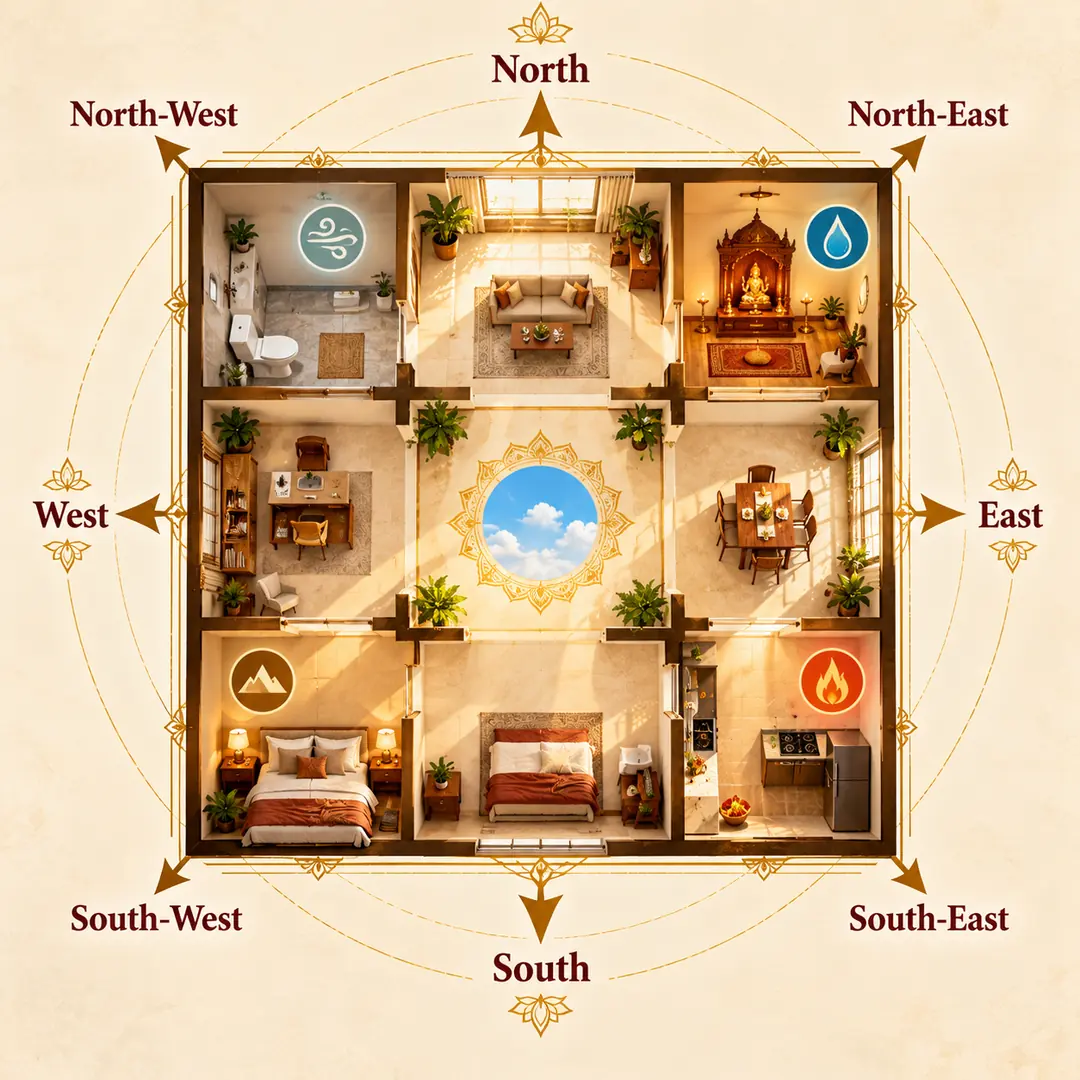
| Direction | Sanskrit name | Guardian deity | Element / quality | Best for | Avoid |
|---|---|---|---|---|---|
| North-East | Ishanya | Ishana (Shiva) | Water; most sacred zone | Puja room, meditation, open space, water tank (underground) | Toilet, kitchen, heavy storage, staircase |
| East | Purva | Indra | Sunrise, health, growth | Main door, living room, windows, study | Toilet, heavy walls with no openings |
| South-East | Agneya | Agni | Fire | Kitchen, electrical panel, inverter | Bedroom of a young couple, water tank, puja room |
| South | Dakshina | Yama | Stability, strength | Bedrooms, heavy furniture, storage | Main entrance (unless correctly placed), open space |
| South-West | Nairutya | Nirrti | Earth | Master bedroom, locker, heaviest furniture | Main door, toilet, kitchen, pit or basement |
| West | Paschima | Varuna | Gains, results | Dining room, children’s room, study, overhead tank | Puja room |
| North-West | Vayavya | Vayu | Air, movement | Guest room, toilet, garage, alternative kitchen, daughter’s room | Master bedroom, locker |
| North | Uttara | Kubera | Wealth, opportunity | Main door, living room, cash locker opening north, open space | Toilet, kitchen, clutter |
| Centre | Brahmasthan | Brahma | Space (Akasha) | Kept open, light, clutter-free | Toilet, staircase, pillars, heavy furniture |
Element note: the most common mapping is Water in the north-east, Fire in the south-east, Earth in the south-west, Air in the north-west and Space at the centre. Some schools, especially those that divide the home into 16 zones of 22.5° each, place the elements a little differently. The room advice above stays the same in almost every school.
How to check the vastu of your home (with a phone)
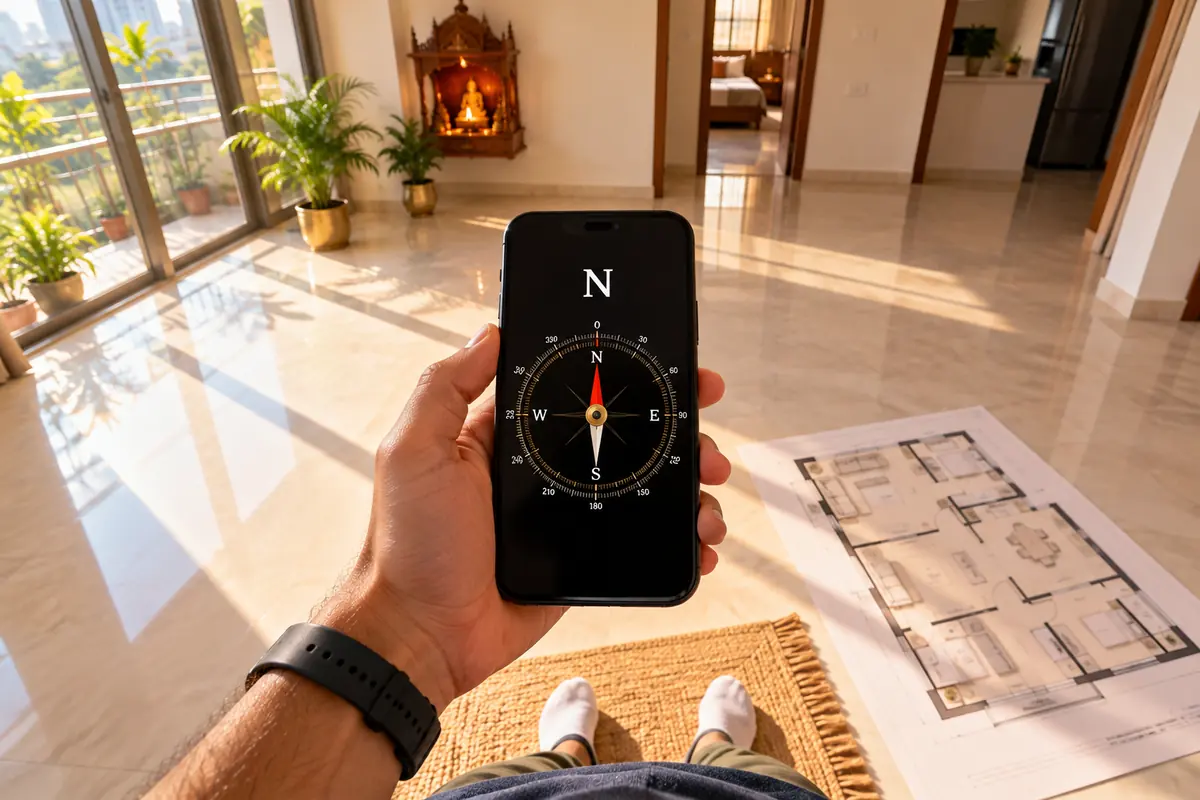
- Get a floor plan. The builder’s brochure plan works. If you have none, sketch the rooms roughly to scale.
- Find the centre. Draw diagonals across the outer walls of the home. Where they cross is the Brahmasthan. For L-shaped homes, use the main rectangle.
- Calibrate your compass. Open your phone’s compass app and move the phone in a figure-of-eight until it is accurate.
- Stand at the centre, away from metal. Keep away from the fridge, inverter, steel almirah, TV and pillars with steel rods. Hold the phone flat. Take two or three readings and use the average.
- Mark north on the plan, then draw the eight directions from the centre. Each of the eight directions covers 45°; north is roughly 337.5° to 22.5° on your compass.
- Note what sits in each zone. Kitchen, toilets, main door, master bedroom, puja and staircase. Compare with the chart above.
The facing of a house is the direction you look in when you walk out of the main door. In a flat, use the flat’s own entrance, not the building gate.
The 5 things to fix first
Not every vastu rule carries the same weight. In my experience, these five matter most. If they are right, small defects elsewhere matter far less.
- Main entrance: clean, well lit, nothing broken, nothing blocking it.
- North-east: clean, light and uncluttered. No toilet, dustbin or heavy storage.
- Kitchen fire: the stove in the south-east (or at least in the south-east part of the kitchen), with the cook facing east.
- Master bedroom: in the south-west, or at least the head of the family’s bed in the south-west part of their room.
- Brahmasthan: the centre kept open and light.
25 vastu tips for home, room by room
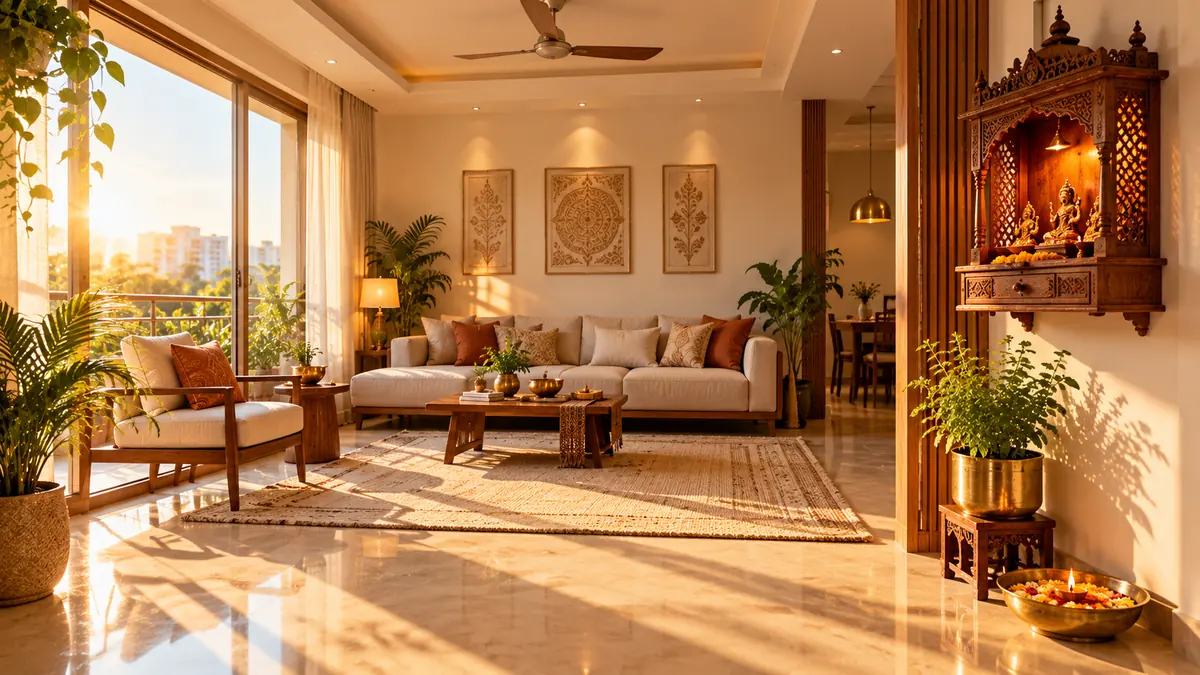
Main entrance (tips 1–4)
- Best directions for the main door: north, east or north-east. A west door is fine in many cases. Doors in the south and south-west need more care.
- Make it the largest and strongest door in the home, opening inwards and clockwise without a creak.
- Keep the entrance bright and clean. Add a nameplate, a toran of mango leaves or a swastika or Om symbol. No shoe rack piled directly in front of the door, and no dustbin outside it.
- Avoid a mirror directly facing the main door. It is believed to push energy back out. A mirror on a side wall is fine.
Living room (tips 5–7)
- Place the living room in the north, east or north-east.
- Put heavy sofas along the south and west walls, so the family faces north or east while sitting.
- Keep the TV in the south-east corner of the room, and the north-east corner light and open.
Kitchen (tips 8–11)
- Kitchen direction as per vastu: south-east first, north-west second. Avoid the north-east and the centre of the home.
- Place the stove so the cook faces east. This applies to a 2 or 3 burner gas stove alike.
- Keep fire and water apart. The sink in the north-east part of the kitchen; the stove in the south-east. Don’t place them side by side, or put a small partition between them.
- Fridge in the south-west or west of the kitchen, at least a few inches from the wall. Store heavy grains in the south or west.
Bedroom (tips 12–16)
- Master bedroom in the south-west. This gives the head of the family stability and authority.
- Sleep with your head to the south (east is the next best). Never sleep with your head to the north.
- Bed in the south-west part of the room, with a solid headboard against a wall, not under a beam.
- No mirror facing the bed. If the wardrobe mirror faces it, cover it at night.
- Soft, earthy colours — light pink, peach, cream, light brown. Avoid harsh red or black on large walls. Children’s rooms work well in the west; guest rooms in the north-west.
Puja room (tips 17–19)
- Puja room or corner in the north-east, or in the east or north if the north-east isn’t possible.
- Face east or north while praying. Idols should not face each other or be placed directly on the floor.
- Never above, below or next to a toilet, and not under a staircase. In a flat, a wall-mounted mandir in the north-east of the living room works well.
Toilets and bathrooms (tips 20–21)
- Toilets in the west or north-west. Never in the north-east or the centre.
- Keep the toilet door closed and the seat lid down. Ensure good ventilation and an exhaust fan; fix leaks quickly.
Staircase, colours, plants and more (tips 22–25)
- Staircase in the south, west or south-west, climbing clockwise. Never in the north-east or centre.
- Vastu plants for home: tulsi in the north or north-east, money plant in the south-east, bamboo in the east. Avoid thorny plants (except roses) and bonsai inside the house.
- Wall clock on the north or east wall. Remove stopped or broken clocks.
- Declutter regularly. Broken items, old newspapers and unused electronics block energy, especially in the north and north-east.
Where vastu experts disagree (and the rule I follow)
- Bed head south or east? Both are accepted. South is best for adults and sound sleep. East is often preferred for students because it supports learning. Only north is avoided.
- Can the bedroom be in the north-east? Many websites say yes for flats. I advise against a master bedroom there. It is the most sacred, lightest zone. If you have no choice, use it for elderly family members or as a light, minimal room.
- Staircase south-west or north-west? South-west, south or west is the safest choice. North-west is acceptable if nothing else is possible. Never the north-east.
- Toilet in the north-west or west? Both are acceptable. Avoid north-east, south-west and the centre.
When two rules conflict, I go back to first principles: keep the north-east light and pure, keep the south-west heavy and stable, keep fire in the south-east and the centre open.
Is an east, west, north or south facing house good?
No direction is bad in itself. What matters more is where on that wall the main door sits and how the rest of the home is planned.
- East facing: very auspicious, because of the morning sun. Keep the door in the north part of the east wall.
- North facing: excellent for wealth and opportunity. Keep the door in the centre or towards the north-east.
- West facing: good for business and gains when the door is placed correctly (towards the north-west part of the west wall).
- South facing: not “bad”, despite its reputation. Many successful homes face south. The door should be towards the south-east part of the south wall, not the south-west.
Vastu for flats and rented homes: remedies without breaking walls
Most vastu for home advice assumes you are building from scratch. In a flat you can’t move the kitchen or a toilet, but you can still change a lot:
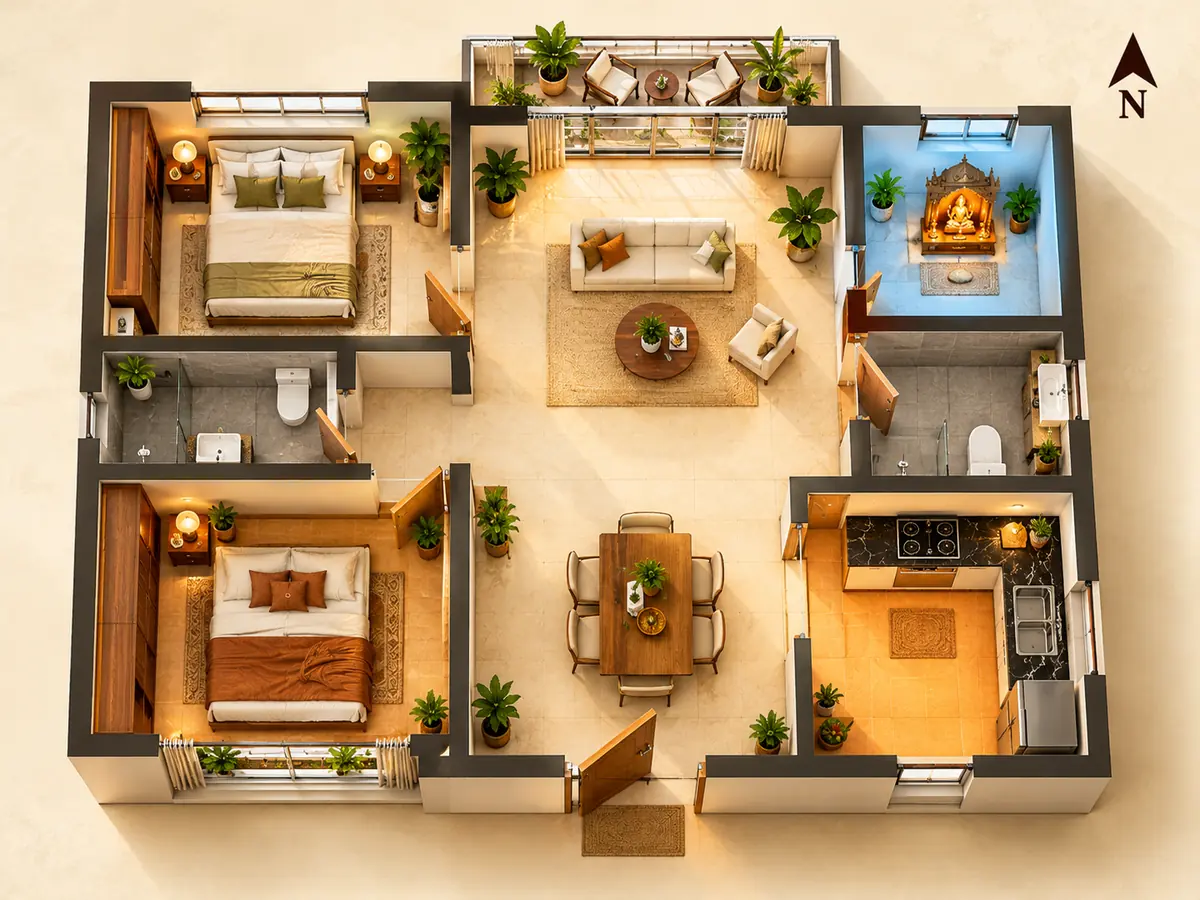
- Rearrange first. Moving the bed, the stove’s position, the desk or the locker costs nothing and often fixes the most important points.
- Toilet in the north-east: keep it spotless, door always closed, and place a bowl of sea salt inside (change it weekly). A light-coloured door helps.
- Kitchen in the north-east: keep the stove in the south-east corner of the kitchen if you can, cook facing east, and keep the area very clean and bright.
- Main door in the south-west: a brass or copper strip at the threshold, a bright light above the door and a well-kept nameplate are common remedies.
- Cut or missing corners: a mirror on the wall of the missing zone, a plant, or a light can visually “extend” it.
- Brahmasthan: clear the centre of heavy furniture. A rug and soft light are enough.
- Light and air: open east and north windows in the morning. Fresh air and sunlight are the simplest vastu remedy there is.
Want me to look at your floor plan?
Send me your plan with north marked (or a photo of the brochure). I’ll tell you what is fine, the few things worth fixing, and simple remedies that don’t need any construction.
Vastu myths
- “A south facing house is unlucky.” Not true. Door placement and the overall plan matter much more.
- “Vastu dosh means you must demolish.” Almost never. Most defects are handled by rearranging and simple remedies.
- “More vastu products = better vastu.” A clean, light, well-ventilated home does more than a shelf of pyramids and crystals.
- “One wrong room ruins everything.” Vastu looks at the whole home. If the five priority points are right, one imperfect room has a small effect.
Vastu checklist for your home
| Check | Yes / No |
|---|---|
| Main door in the north, east or north-east (or correctly placed on its wall) | |
| Entrance clean, bright, no mirror facing it | |
| North-east clean, light, no toilet or heavy storage | |
| Kitchen stove in the south-east, cook facing east | |
| Master bedroom in the south-west | |
| Sleeping with the head to the south or east | |
| No mirror facing the bed | |
| Puja in the north-east, not near a toilet | |
| Toilets in the west or north-west, doors kept closed | |
| Centre of the home open and clutter-free | |
| Heavy furniture along the south and west walls | |
| No broken clocks, leaking taps or clutter |
Nine or more “yes” answers means your home is in good shape. Start fixing any “no” from the top of the list.
Vastu terms explained
- Ishanya: north-east zone, ruled by Ishana (Shiva).
- Agneya: south-east zone, ruled by Agni (fire).
- Nairutya: south-west zone, ruled by Nirrti.
- Vayavya: north-west zone, ruled by Vayu (air).
- Brahmasthan: the centre of the home.
- Vastu Purusha Mandala: the grid used to map a building onto the directions.
- Pancha Bhoota: the five elements — earth, water, fire, air and space.
- Vastu dosh: a defect in the placement of a room, door or element.
From my readings
When I look at a home, I don’t start with a list of faults. I start with the people. A family under financial strain, a couple who argue constantly, a child who can’t concentrate — each points me to a particular zone. Then I check the birth charts too, because the direction that suits one family member may not suit another. A kundli reading shows each person’s favourable direction for sleeping and working.
A young couple in a Noida 2BHK told me they argued every night and both slept badly. Their flat faced east and was well planned, but they had given the south-west master bedroom to visiting parents and were sleeping in the north-east room with their heads to the north, a large mirror facing the bed and a work desk piled beside it. We swapped rooms, turned the bed so their heads pointed south, covered the mirror at night and cleared the north-east room into a study and puja corner. No construction, no products. Within a month they said the evenings felt calmer.
Composite of several consultations; details changed for privacy.
For a full home review alongside your family’s charts, see my spiritual consultation.
घर के लिए वास्तु (हिंदी में सारांश)
वास्तु शास्त्र दिशाओं और पंचतत्वों के अनुसार घर बनाने और सजाने की भारतीय परंपरा है। मुख्य नियम: मुख्य द्वार उत्तर, पूर्व या ईशान कोण में; रसोई आग्नेय कोण (दक्षिण-पूर्व) में, खाना बनाते समय मुख पूर्व की ओर; मास्टर बेडरूम नैऋत्य कोण (दक्षिण-पश्चिम) में; पूजा घर ईशान कोण (उत्तर-पूर्व) में; शौचालय पश्चिम या वायव्य कोण में; घर का मध्य भाग (ब्रह्मस्थान) खाली रखें। सोते समय सिर दक्षिण या पूर्व की ओर रखें, उत्तर की ओर नहीं। किराए के घर में तोड़-फोड़ के बिना भी फर्नीचर बदलकर, सफाई, रोशनी और नमक जैसे उपायों से वास्तु दोष कम किया जा सकता है।
Conclusion
Good vastu for home comes down to a few principles: a welcoming entrance, a light and sacred north-east, fire in the south-east, stability in the south-west, and an open centre. Get those right, follow the room tips where you can, and use simple remedies where you can’t. Vastu should make your home feel calmer and more organised, not leave you anxious about every wall.
FAQs
Which direction is best for a home as per vastu?
North and east facing homes are considered the most auspicious, but west and south facing homes are also good when the main door is placed correctly on that wall.
What are the basic rules of vastu for home?
Main door in the north, east or north-east; kitchen in the south-east; master bedroom in the south-west; puja room in the north-east; toilets in the west or north-west; and the centre of the home kept open.
How do I check the vastu of my house?
Find the centre of your floor plan, stand there with a calibrated phone compass away from metal and electronics, mark north, divide the plan into eight directions, and compare each room with the vastu chart.
According to vastu, in which direction should the kitchen be?
South-east is best, and north-west is the accepted alternative. The cook should face east. Avoid a kitchen in the north-east or the centre of the home.
Which direction should I sleep in as per vastu?
Sleep with your head to the south for deep rest, or to the east for learning and focus. Avoid sleeping with your head to the north.
Is a south facing house bad as per vastu?
No. A south facing house can be very good if the main door is in the south-east part of the south wall and the rest of the plan follows vastu.
Where should a mirror be placed in the bedroom?
On the north or east wall, and never directly facing the bed. If a wardrobe mirror faces the bed, cover it at night.
Which plants are good for home as per vastu?
Tulsi in the north or north-east, money plant in the south-east, and bamboo in the east. Avoid thorny plants other than roses, and bonsai indoors.
Can vastu dosh be corrected without demolition?
Yes. Most defects can be reduced by rearranging furniture, keeping key zones clean and bright, and simple remedies like sea salt, metal strips and mirrors.
What is Brahmasthan in vastu?
It is the centre of the home, ruled by Brahma and the space element. It should be kept open, light and free of toilets, staircases, pillars and heavy furniture.
Is vastu scientific?
Vastu is a traditional system, not a lab-proven science. Many of its rules match practical design sense, such as morning light from the east and good ventilation.
What is vastu dosh?
Vastu dosh is a defect in the placement of a room, door or element, such as a toilet in the north-east or a kitchen in the centre. Most are mild and can be balanced with simple remedies.
This article shares traditional Vastu Shastra perspectives for guidance and reflection. Client details, where mentioned, are anonymised. It is not a substitute for structural, legal or professional architectural advice. Never make structural changes without a qualified engineer.