
7 Mukhi Rudraksha: Benefits, Ruling Planet & Who Should Wear It
 By Monica Kapoor · Vedic astrologer & tarot mentor · Masters in Vedic Numerology · 15+ years of practice
Written by me from my consultation practice. Scriptural statements are checked against the Shiva Purana (Vidyeshvara Samhita), Srimad Devi Bhagavatam (Book 11) and the Rudraksha Jabala Upanishad. I sell no rudraksha, gemstones or puja kits, and this page has no affiliate links. Prices are a market snapshot from November 2026 and will be refreshed every six months.
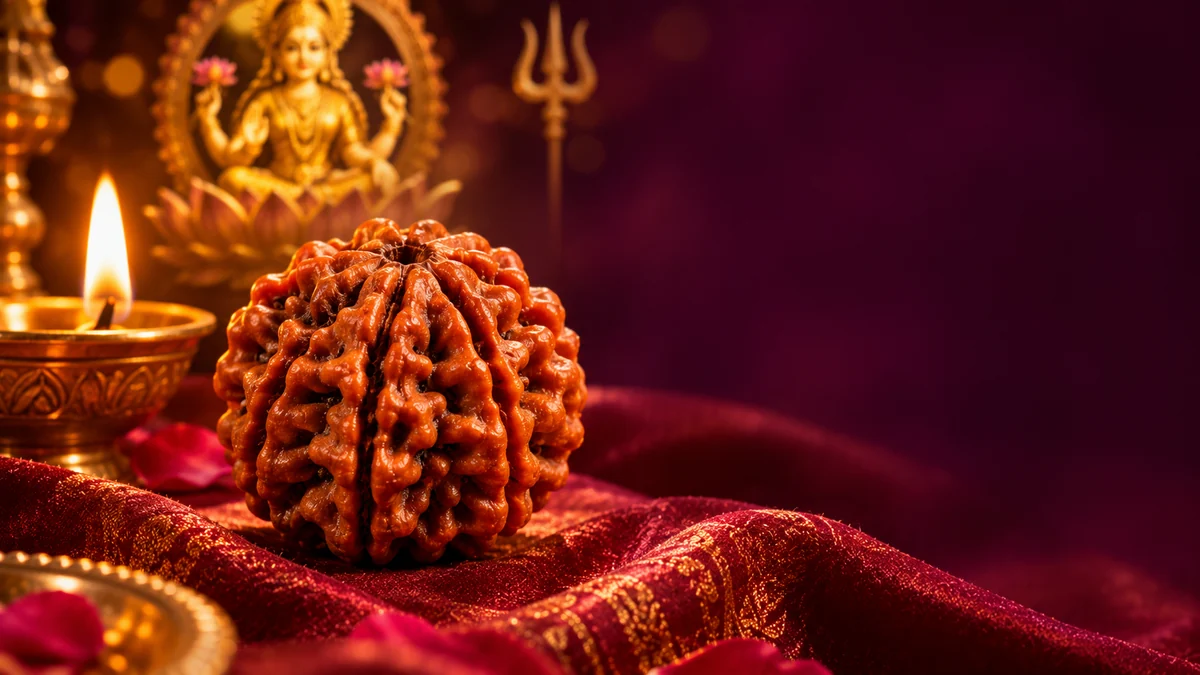
A 7 Mukhi Rudraksha (Saat Mukhi) is a rudraksha bead with seven natural lines running from top to bottom. It is traditionally linked with Goddess Mahalakshmi and its ruling planet is Saturn (Shani). It is worn for steady wealth, patience, discipline and support during difficult Saturn periods such as Sade Sati. Its mantra is “Om Hum Namah”, and it is usually first worn on a Saturday or Monday after cleansing and chanting the mantra 108 times. It is generally considered safe for anyone to wear, but people with a strong Saturn influence in their chart benefit most.
A note before you read: I don’t sell rudraksha, and nothing on this page links to a shop. What follows is what the scriptures say, what I see in charts, and what I tell clients. Rudraksha is a spiritual practice. It is not a medical treatment or a financial guarantee.
What is a 7 Mukhi Rudraksha?
A rudraksha is the dried seed of the Elaeocarpus ganitrus tree, which grows in the Himalayan foothills of Nepal and India and across Indonesia. The “mukhis” (faces) are the natural lines or clefts that run from one end of the bead to the other. A 7 Mukhi Rudraksha has exactly seven of these lines. Inside, a genuine bead has seven seed chambers, one under each face.
Seven is a meaningful number in Hindu tradition: the seven Matrikas (mother goddesses), the seven Rishis, the seven chakras, the seven days, the seven rays of the Sun. All of these come up when people explain the bead.
If you want a broader introduction to how mukhis are counted and all 14 types, read my guide to types of rudraksha (1 to 14 Mukhi). This page goes deep on the 7 Mukhi alone.
7 Mukhi Rudraksha at a glance
| Attribute | 7 Mukhi Rudraksha |
|---|---|
| Other names | Saat Mukhi, Seven Mukhi, 7 Face Rudraksha |
| Ruling planet | Saturn (Shani); a minority of later sources say Venus |
| Main deity | Goddess Mahalakshmi |
| Scriptural forms | Ananga (Kamadeva) in the Shiva Purana and Devi Bhagavatam; Saptamatrika and the Saptarishis in other texts |
| Beej mantra | Om Hum Namah (ॐ हुं नमः) |
| Best day to first wear | Saturday (for Saturn) or Monday (for Shiva); Friday for Lakshmi devotees |
| Traditional thread/metal | Red or black silk/cotton thread, or silver cap. Silver is preferred for Saturn |
| Where to wear | Around the neck (bead resting near the heart) or on the right wrist |
| Main intentions | Steady wealth, patience, discipline, relief in Saturn periods, career consistency |
| Most suited rashis/lagnas | Capricorn (Makar) and Aquarius (Kumbh); also Taurus and Libra, where Saturn is a yogakaraka |
| Sizes commonly seen | Nepali about 14–24 mm; Indonesian (Java) about 6–14 mm |
Ruling planet and deity: Saturn, Mahalakshmi or Ananga?
If you’ve read a few websites, you’ve probably seen different answers. Here is why.
Saturn
The scriptures that describe rudraksha (the Puranas and Upanishads) don’t assign planets to mukhis at all. The planet links are a later astrological layer, built on the nine planets and the numbers 1 to 9. In that system seven is Saturn’s bead. Most astrologers today, including me, work with Saturn. You’ll occasionally see Venus mentioned, because in some numerology systems 7 is linked with Ketu or Venus. In practice, it is a Saturn remedy.
Mahalakshmi
This is the most widely followed association today, and it is why the bead is so popular for wealth. It fits with Saturn too. Saturn gives slowly but lastingly, and the 7 Mukhi is worn for steady abundance, not sudden luck.
Ananga, Saptamatrika, Saptarishis
These come from the older texts (see the next section). They are not in conflict: each text focuses on a different aspect of the same bead.
What the scriptures actually say
Very few rudraksha articles name their sources. Here is a short summary of the main texts:
- Shiva Purana (Vidyeshvara Samhita, chapter on Rudraksha): describes the seven-faced bead as a form of Ananga (Kamadeva). It says a poor person who wears it becomes prosperous, which is the scriptural root of its link with wealth. This chapter also gives “Om Hum Namah” as the mantra for the seven-faced bead.
- Srimad Devi Bhagavatam (Book 11, Rudraksha Mahatmya): also names the seven-faced bead Ananga and says that wearing it frees one from the sin of stealing gold, among other sins.
- Rudraksha Jabala Upanishad: connects the seven-faced bead with the Saptamatrikas (seven mother goddesses), as well as the Sun and the Saptarishis. It says the bead gives wealth, health, knowledge and purity.
- Padma Purana: included in rudraksha lists and quoted by later authors, generally following the same seven-mother theme.
So “7 Mukhi = wealth” is not marketing. It goes back to the texts. What the texts do not say is that the bead fixes debts overnight or cures disease. Those are modern claims.
7 Mukhi Rudraksha benefits
These are the benefits described in tradition and those I see people report in practice. I’ve grouped them honestly.
Saturn support
- Supports you through Saturn periods: Sade Sati, Shani Mahadasha or Antardasha, Dhaiya (Shani’s 2.5-year transit), and a Saturn under pressure in the birth chart. This is the bead’s main astrological use.
- Invokes Mahalakshmi. Used in daily Lakshmi sadhana, especially by people in business.
- Steadies the mind for discipline. Saturn’s positive side is focus, routine and patience.
- Root-chakra grounding. Many energy-healing traditions use it for the Muladhara chakra. This is a modern practice, not a scriptural one.
As tradition describes them
- Helps with financial stability and better money habits rather than sudden gains
- Traditionally worn by business owners, traders and people in finance for steady growth
- Supports career consistency for people whose work keeps stalling or starting over
- Used as a remedy when hard work is not being rewarded, a classic Saturn complaint
Calm and patience
- Wearers commonly describe feeling calmer, more patient and less fearful about the future
- It acts as a daily anchor for prayer or mantra, which itself can be steadying
Some websites say the 7 Mukhi cures arthritis, nerve pain, depression or “ensures” wealth. I don’t make those claims and you shouldn’t rely on them. If you have a health condition, please see a doctor. Rudraksha can sit alongside treatment as a spiritual support, never in place of it.
7 Mukhi Rudraksha benefits for female and male wearers
The bead works the same for everyone. Women commonly wear it for financial independence, steadiness in a career break or return, and Lakshmi sadhana. Men commonly wear it for business growth, career stagnation and Sade Sati. Women can wear rudraksha. There is no scriptural ban, and I discuss the menstruation question in the rules section.
Who should wear a 7 Mukhi Rudraksha?
The 7 Mukhi is one of the safest beads to wear, but it gives the most benefit to:
- People going through Sade Sati or Shani Dhaiya. Check your Moon sign against Saturn’s current transit.
- People in Saturn Mahadasha or Antardasha. Saturn’s Mahadasha lasts 19 years, so this is a long-term companion.
- Capricorn (Makar) and Aquarius (Kumbh) rashi or lagna. Saturn is your chart ruler.
- Taurus (Vrishabh) and Libra (Tula) lagna. Saturn is a yogakaraka (a planet that brings good results) for you.
- People born in Saturn’s nakshatras: Pushya, Anuradha and Uttara Bhadrapada. (See all 27 nakshatras and their ruling planets.)
- Business owners, traders and people in finance who want steadiness rather than speculation.
- Anyone whose effort isn’t paying off, especially with repeated delays, debts or setbacks. These are classic signs of a stressed Saturn.
7 Mukhi Rudraksha for which rashi?
| Rashi / Lagna | Suitability | Why |
|---|---|---|
| Makar (Capricorn) | Very suitable | Saturn is the lord |
| Kumbh (Aquarius) | Very suitable | Saturn is the lord |
| Vrishabh (Taurus) | Very suitable | Saturn is the yogakaraka |
| Tula (Libra) | Very suitable | Saturn is the yogakaraka and is exalted in Libra |
| Mithun (Gemini), Kanya (Virgo) | Suitable | Saturn is a friendly planet |
| Mesh (Aries), Kark (Cancer), Simha (Leo), Vrishchik (Scorpio) | Wear for Sade Sati/dasha relief; check the chart first | Saturn is a functional malefic or rules difficult houses |
| Dhanu (Sagittarius), Meen (Pisces) | Neutral; wear with an astrologer’s guidance | Jupiter-ruled signs; Saturn rules wealth/gain houses here |
Remember: rashi tables are a shortcut. The tradition does not forbid the 7 Mukhi to any rashi. I always check Saturn’s house and strength before recommending it.
Who should think twice
There are very few hard “no” cases, but I’d pause if:
- You want instant money. The 7 Mukhi works like Saturn: slow and steady. If you expect a windfall, you’ll be disappointed.
- You’re buying out of fear. Be wary of anyone telling you that something terrible will happen unless you buy an expensive bead. That is fear-based selling, not astrology.
- You’ve been told to replace professional help with it. Debt, legal trouble, health or mental health issues need qualified people. The bead can support you, not substitute for them.
- You have a skin sensitivity or metal allergy. Choose a cotton or silk thread and avoid dyed or chemically polished beads.
- You’re buying for a young child. Traditionally, beads with more mukhis are given to children only on a teacher’s or astrologer’s advice. A 5 Mukhi is the common gentle choice.
How to wear a 7 Mukhi Rudraksha (step by step)
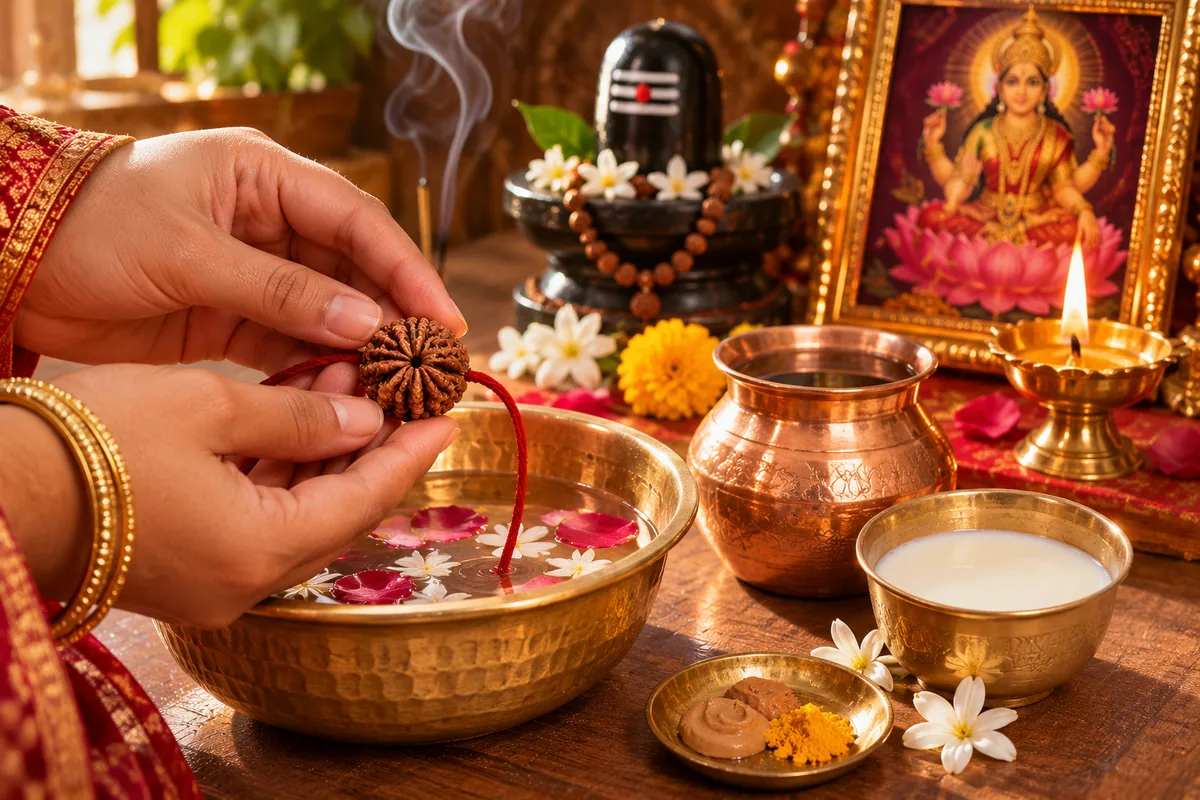
This is the simple vidhi I give clients. You don’t need a priest for it.
- Choose the day. Saturday morning is customary for Saturn. Monday (Shiva’s day) suits any rudraksha. Friday suits Lakshmi devotees. Avoid Rahu Kaal. A Pushya Nakshatra or Shukla Paksha day is a nice extra, but it is not required.
- Bathe and wear clean clothes. Sit facing east or north.
- Cleanse the bead. Soak it briefly in clean water, then dip or sprinkle it with raw milk or Gangajal. Rinse and pat dry. No soap.
- Place it before your altar. Use a picture of Shiva and/or Mahalakshmi. Light a ghee or sesame-oil diya and incense. Offer a flower and a little sandalwood paste on the bead.
- Chant the mantra 108 times: “Om Hum Namah” (ॐ हुं नमः). Many people also chant Om Namah Shivaya, or Om Shreem Mahalakshmyai Namah for Lakshmi.
- Wear it around the neck so it rests near the heart, or on the right wrist.
- Continue daily with at least 11 (ideally 108) repetitions of the mantra, especially in the first 40 days.
Thread or metal? Red or black silk/cotton thread is traditional. If you prefer metal, silver suits Saturn well. Gold is also used, mainly for Lakshmi sadhana. Make sure the bead touches the skin.
Wearing rules and care
Different households follow these with different strictness. Here is what is traditional, and how I advise on it:
| Rule | Traditional view | My practical advice |
|---|---|---|
| Remove for bathing with soap/shampoo | Yes | Yes, because soap and chlorine dry out and crack the bead |
| Remove while sleeping | Often advised | Optional. Remove it if it’s uncomfortable or may break |
| Non-veg and alcohol | Many remove it | Remove it before alcohol/non-veg if your family follows this |
| Funerals / cremation ground | Remove | Remove and keep it at home |
| Menstruation | Some families remove it | Not forbidden in the scriptures. Follow your own comfort and family custom |
| Lending it to someone else | Don’t | Don’t. It’s personal |
| Oiling | Monthly | Rub a drop of sandalwood or mustard oil monthly to stop drying |
| Broken bead | Retire it | Thank it and place it in flowing water or under a tree |
Nepali vs Indonesian 7 Mukhi Rudraksha
| Feature | Nepali 7 Mukhi | Indonesian (Java) 7 Mukhi |
|---|---|---|
| Typical size | About 14–24 mm | About 6–14 mm |
| Lines | Deep, clearly cut clefts | Fine, shallow lines |
| Surface | Prominent thorny “hills” | Smoother |
| Common use | Single pendant or bracelet | Malas and bracelets |
| Price | Higher | Lower |
| Spiritual strength | Equal in the scriptures | Equal in the scriptures |
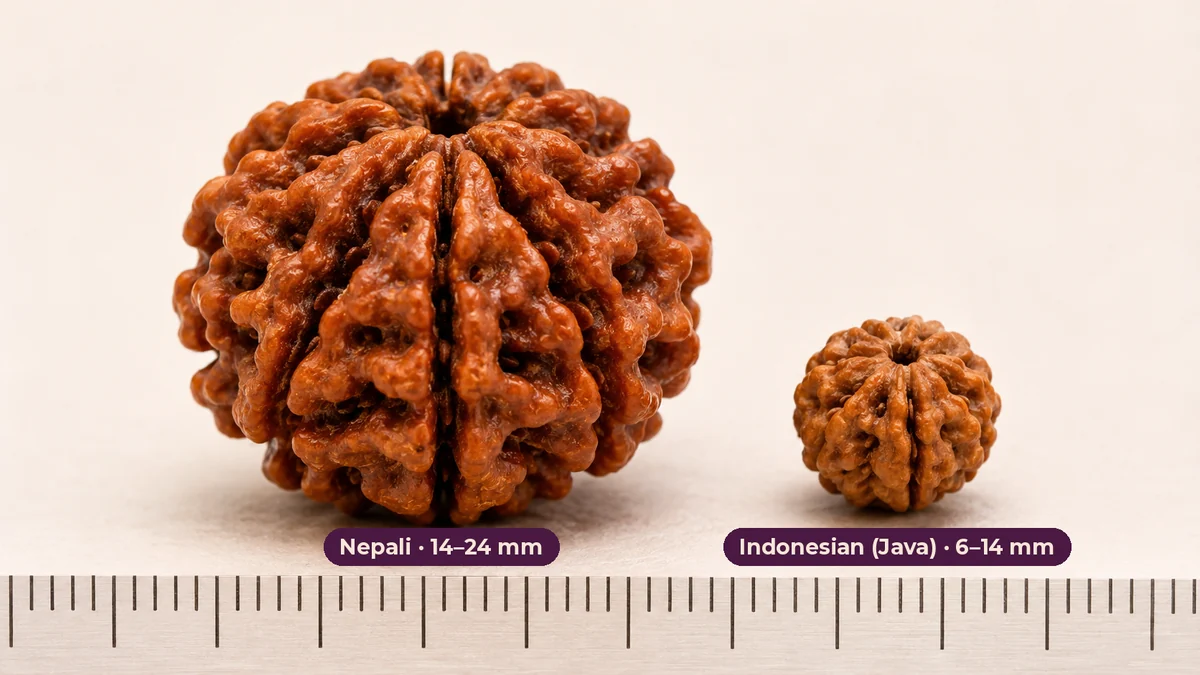
You’ll read that Nepali beads are “more powerful”. The scriptures don’t say that, and I don’t believe it’s true. The difference is mainly size, how clearly you can see the lines, and price. Choose what fits your budget and is genuine. That matters far more than origin.
How to identify an original 7 Mukhi Rudraksha
The 7 Mukhi is commonly faked by carving extra lines onto a cheaper 5 Mukhi or 6 Mukhi. Here’s how to protect yourself, from most to least reliable:
- X-ray or CT report from a lab. A real 7 Mukhi shows seven internal seed chambers. This is the only conclusive test.
- Trace every line with a fingernail or magnifier, from one end to the other. Natural lines run unbroken from the top hole to the bottom. Carved lines often stop short, look too straight, or show tool marks inside the groove.
- Check the ends. Natural lines meet at the poles. Glued or carved lines often look different near the holes.
- Water test: this only rejects. A bead that floats may be hollow, dried out or fake. But a bead that sinks is not proven genuine, since wood or resin fakes can sink too.
- Avoid the “copper coin” and “rotation” tests. They have no reliable basis.
- Lab certificate. Useful, but make sure it is from an independent gemmological lab, includes an X-ray image, and matches the bead’s size and weight.
Red flags: very low prices for big “Nepali” beads, perfectly identical beads in a set, strong dye smell, or a seller who refuses an X-ray.
7 Mukhi Rudraksha price guide
Indicative market ranges in India (November 2026). Prices vary widely with size, origin and certification:
| Type | Typical range |
|---|---|
| Indonesian single bead (6–12 mm) | ₹100 – ₹600 |
| Indonesian 7 Mukhi bracelet / mala | ₹800 – ₹6,000 |
| Nepali bead, small (14–17 mm) | ₹500 – ₹1,500 |
| Nepali bead, medium (18–21 mm) | ₹1,000 – ₹3,000 |
| Nepali bead, large (22 mm+) | ₹2,500 – ₹6,000+ |
| Lab X-ray certificate | Often included, or ₹300 – ₹1,000 extra |
What decides the price: origin, size, how clear the lines are, whether the bead is natural (not cut or joined), and an X-ray certificate. A bigger bead is not a “stronger” bead. Don’t let anyone upsell you on size alone.
Combinations with other mukhis
| Combination | Traditional purpose |
|---|---|
| 7 + 5 Mukhi | The everyday pairing: Saturn steadiness with 5 Mukhi’s calm (Jupiter/Kalagni Rudra) |
| 7 + 8 Mukhi | Saturn plus Rahu (Ganesha) for removing obstacles in business |
| 7 + 10 Mukhi | Lakshmi with Vishnu, worn for protection and family prosperity |
| 7 + 14 Mukhi | A strong Saturn combination for Sade Sati; 14 Mukhi is costly, so use it only on advice |
| 7 + 9 + 11 Mukhi | Career and leadership combination |
Combinations should be chosen from the chart, not from a product page. If an 8 Mukhi comes up for you, my guide to Rahu and Ketu in astrology explains the Rahu side.
7 Mukhi Rudraksha side effects: the honest answer
The rudraksha scriptures describe no side effects for genuine beads, and the 7 Mukhi is considered safe for everyone. In practice, the only issues I see are:
- Skin irritation from dyed beads, chemical polish or metal allergy
- Disappointment when someone expected overnight results
- Restlessness or heaviness that a few sensitive people report in the first weeks. This usually settles. If it doesn’t, remove the bead and have your chart checked
If you hear that a 7 Mukhi “goes against” your rashi and will harm you, ask for the chart reasoning. Fear is not a remedy.
How I decide whether to recommend a 7 Mukhi
Clients often arrive having already been told to buy a 7 Mukhi. Before I agree, I check four things in the chart:
- Is Saturn actually the problem? I look at Saturn’s house, sign, aspects and the current transit over the Moon. If the delays come from Rahu, a weak Jupiter or a stressed Moon instead, a 7 Mukhi is the wrong tool. An 8 Mukhi, 5 Mukhi or 2 Mukhi may suit better.
- Which dasha is running? A 7 Mukhi makes most sense in a Saturn Mahadasha or Antardasha, during Sade Sati, or in a Saturn Dhaiya. Outside these periods, I want a clear Saturn reason in the birth chart.
- Is Saturn a friend to the Lagna? For Taurus, Libra, Capricorn and Aquarius Lagna, Saturn is a supportive planet and the bead strengthens a friend. For Cancer, Leo, Aries and Scorpio Lagna I am more careful, and I recommend the bead for relief, not to “boost” Saturn.
- What does the client expect? If the expectation is a sudden windfall, I explain Saturn’s way first. A bead worn with the wrong expectation usually gets abandoned within weeks.
Not everyone who asks me about a 7 Mukhi needs one. Some need a different mukhi, a different remedy, or nothing at all.
From my readings
A Kumbh-lagna client in his mid-forties came to me in the second phase of Sade Sati. His income had flattened, two business deals had collapsed and he wanted “the most powerful rudraksha”. He didn’t need an expensive bead. He needed a medium Nepali 7 Mukhi, Saturday seva, and, honestly, a better accounting routine. The bead became his daily reminder to work Saturn’s way: slowly and correctly. A year later, things weren’t magically fixed, but they were steady, and that is what Saturn rewards.
Composite of several readings; details changed for privacy.
7 मुखी रुद्राक्ष (हिंदी में सारांश)
7 मुखी रुद्राक्ष पर ऊपर से नीचे तक सात प्राकृतिक रेखाएं होती हैं। इसकी अधिष्ठात्री देवी महालक्ष्मी हैं और ग्रह शनि है। शिव पुराण में इसे अनंग का स्वरूप बताया गया है, जो दरिद्रता दूर करता है। इसे धन में स्थिरता, धैर्य, अनुशासन और शनि की साढ़ेसाती या महादशा में सहारे के लिए पहना जाता है। मंत्र: ॐ हुं नमः (108 बार)। इसे शनिवार या सोमवार को गंगाजल या कच्चे दूध से शुद्ध करके लाल या काले धागे या चांदी में पहनें। मकर, कुंभ, वृषभ और तुला राशि/लग्न वालों के लिए यह विशेष लाभकारी माना जाता है। असली की पहचान का सबसे पक्का तरीका X-ray है, जिसमें सात आंतरिक खाने दिखते हैं।
Conclusion
The 7 Mukhi Rudraksha is Saturn’s bead and Mahalakshmi’s blessing at the same time: slow, steady abundance earned through patience and right action. It is one of the most useful beads for anyone in a Saturn period, for Capricorn, Aquarius, Taurus and Libra charts, and for people building something long-term. Buy a genuine bead (X-ray if you can), wear it simply with “Om Hum Namah”, and pair it with Saturn’s real remedy: discipline.
If you’re not sure whether the 7 Mukhi is right for your chart, or whether you need a different mukhi altogether, I can check it for you in a Kundli reading. For wealth-specific remedies, see my abundance and prosperity alignment work.
Not sure a 7 Mukhi is right for your chart?
I don’t sell rudraksha, so my only interest is in recommending the right bead, or none.
FAQs
What is the ruling planet of 7 Mukhi Rudraksha?
Saturn (Shani) is the ruling planet of the 7 Mukhi Rudraksha in modern astrological practice. A few sources mention Venus. The bead’s deity is Goddess Mahalakshmi.
Who should wear 7 Mukhi Rudraksha?
People going through Sade Sati, Shani Dhaiya or Saturn Mahadasha. Also Capricorn, Aquarius, Taurus and Libra rashi or lagna, people born in Pushya, Anuradha or Uttara Bhadrapada nakshatra, and business owners wanting steady financial growth.
What are the main benefits of 7 Mukhi Rudraksha?
Traditionally it is worn for steady wealth and financial stability, Mahalakshmi’s blessings, patience and discipline, career consistency and relief during difficult Saturn periods.
What is the mantra for 7 Mukhi Rudraksha?
The beej mantra given in the Shiva Purana is “Om Hum Namah” (ॐ हुं नमः), chanted 108 times when you first wear it and daily after that.
Which day is best to wear 7 Mukhi Rudraksha?
Saturday is customary because Saturn rules the bead. Monday, Shiva’s day, is also widely used, and Friday suits Lakshmi devotees. Avoid Rahu Kaal.
Can women wear 7 Mukhi Rudraksha?
Yes. There is no scriptural restriction on women wearing rudraksha, including the 7 Mukhi. Removing it during menstruation is a family custom some follow, not a scriptural rule.
Does 7 Mukhi Rudraksha have side effects?
The scriptures describe no side effects for genuine rudraksha. Practical issues are limited to skin irritation from dyed beads or metal, and unrealistic expectations. It is not a medical treatment.
How can I check if my 7 Mukhi Rudraksha is original?
The only conclusive test is an X-ray showing seven internal seed chambers. At home, trace each line from end to end. Carved lines often stop short or show tool marks. The water test can only reject a bead, not confirm it.
Can I wear 7 Mukhi Rudraksha while sleeping?
You can, but many people remove it at night to avoid damaging the bead or the thread. Keep it on your altar or in a clean cloth.
Is Nepali 7 Mukhi better than Indonesian?
Not spiritually. The scriptures make no difference between them. Nepali beads are larger with deeper lines and cost more. Indonesian beads are smaller and more affordable. Choose a genuine bead that fits your budget.
What is the price of an original 7 Mukhi Rudraksha?
In India, an Indonesian 7 Mukhi bead typically costs ₹100 to ₹600, and a Nepali one ₹500 to ₹6,000 or more depending on size and certification (indicative, November 2026).
Can I wear 7 Mukhi with other rudraksha?
Yes. Common combinations are 7 with 5 Mukhi for everyday wear, 7 with 8 Mukhi for removing obstacles, and 7 with 14 Mukhi for Sade Sati. Choose combinations based on your chart.
Spiritual and astrological guidance is for personal reflection. It is not a substitute for qualified medical, legal, financial or psychological advice. Prices are indicative market ranges and will vary by seller. Monica Kapoor does not sell rudraksha or gemstones.